This season can often be a worrying time for an owner whose dog has a fear of noise. Halloween, Diwali and Bonfire Night bring the sights and sounds of fireworks, while private displays can begin with very little warning. For some dogs, this might mean a little extra vigilance or wanting to stay close to their person. For others, fireworks can trigger trembling, panting, pacing, hiding, escape attempts or an inability to settle long after the last bang has finished.

Noise fears are common in dogs, and research suggests that they can worsen or generalise over time, particularly following repeated frightening experiences. The good news is that there are things we can do, both on the night and longer term.
Fear of noises: on the night
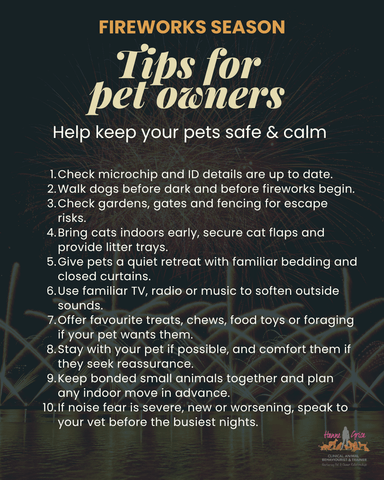
- Get your walk in before it gets dark, and well before fireworks are likely to start. Choose somewhere away from known displays. Keep your dog’s collar and ID tag on and check that their microchip details are up to date, just in case they are suddenly frightened and bolt.
- Secure your garden. Check fencing and gates during daylight for any gaps. For the evening pee or poo, go outside with your dog and consider keeping them on lead if there is any risk they may panic and run.
- Stay with your dog if you know they struggle. If possible, arrange your evening around them. A dog who finds fireworks frightening is unlikely to appreciate being left to deal with the neighbourhood pyrotechnics alone.
- Create a safe place. This should be somewhere your pet can retreat to, away from the busiest parts of the house, ideally with curtains or blinds closed and familiar bedding available. An old T-shirt or blanket carrying familiar household smells may make the area feel more familiar too. The important bit is that your dog chooses to use it – a “safe place” is only safe if they think so.
- Use familiar background sound. Television, radio or music can help soften the contrast between a quiet room and a sudden explosion outside. Keep the volume comfortable. You are aiming to take the edge off the external noise, rather than compete with it.
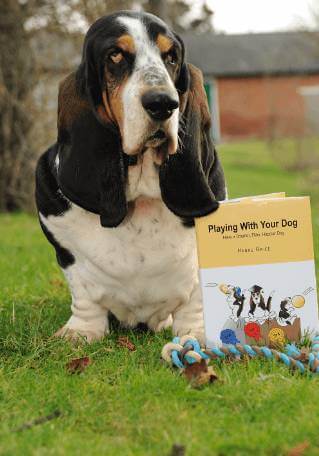
- Offer food, play or scent activities if your dog wants them. If your dog hears a bang and is still able to eat, you can pair the noise with something good: a scatter of treats, a favourite chew, a food toy or a short game. Think: bang = chicken appears. If your dog normally enjoys food but cannot eat, that indicates they may be too worried to engage. For game ideas and more, check out my book Playing With Your Dog.
- Comfort your dog if they ask for you. Fear is an emotion, and you are not going to “reward” your dog for feeling frightened by offering reassurance. If they seek contact, gentle stroking or simply want to sit beside you, that is fine. If they would rather hide behind the sofa, that is fine too.
- Never grab, shout at or pull your dog out of a hiding place. If they have chosen somewhere to retreat, let them remain there unless there is an immediate safety concern. Give them the choice to emerge when they are ready.
Look at what your dog is telling you
Dogs communicate all the time through visual, vocal and scent cues. While we humans are rather poorly equipped to appreciate their extraordinary olfactory world, we can get better at spotting the more subtle signs that a dog is becoming uneasy. These may include:
- lip or nose licking
- panting when they are not hot
- salivating
- pacing
- whining
- crouching
- a tucked tail
- creeping away
- freezing or stiffening
- dilated pupils
- barking
- shaking off as though wet
- repeatedly changing resting position
- refusing food
- following you from room to room
- refusing to go outside
When observing your dog, be aware of the context. For example, one lip lick is not a diagnosis of fear. Instead, look at the whole dog, what is happening around them, whether several changes are occurring together and how quickly they recover afterwards. That recovery time is important too. In Riemer’s (2019) study of firework fears, many dogs recovered by the following morning, but some remained affected for days, weeks or longer.
Has your dog suddenly become frightened of noise?
If your dog has suddenly become noise-sensitive, particularly if this appears later in life or has become noticeably worse, speak to your vet. Research from the University of Lincoln (Lopes-Fagundes et al., 2018) comparing noise-sensitive dogs with and without musculoskeletal pain found that dogs in the pain group tended to develop their noise sensitivity later and showed greater generalisation to other situations.
Why might this happen? A sudden bang can cause a dog to startle and tense their muscles. If movement already hurts, that startle response may itself be uncomfortable. So, a dog who previously slept through fireworks and now paces, startles or refuses to go outside deserves more than being written off as “getting old” or “being difficult”.
Preparing your dog: start before firework season
If your dog has a noise fear, preparation is key. And, preferably not at 4pm on 5th November.
Carefully planned desensitisation and counterconditioning can help some dogs. This may start with firework recordings played at such a low intensity that your dog remains comfortable, pairing the sound with something they enjoy and gradually increasing the intensity over time.
But fireworks are not just noisy. Flashes of light, changes in the environment and associated scents can also become part of the picture, so these may need to be introduced carefully too. In clinical practice, I will often work across the senses, for example using very low-level visual cues alongside sound work, and adding familiar activities the animal typically enjoys, such as sniffing or foraging, to help the dog remain engaged and comfortable.
The important word here is gradually. Introduce one element at a time, at a level your dog can cope with, before combining them. Playing firework recordings loudly in the hope that a dog will “get used to it” risks doing the opposite. Repeated exposure when the dog is already frightened can increase sensitivity rather than reduce it. A 2023 review of the current evidence found useful support for a combination of methods including counterconditioning, relaxation work and carefully planned training with sound recordings (Riemer, 2023).
For dogs with a well-established or severe noise fear, work through this with a qualified clinical animal behaviourist rather than simply downloading a soundtrack and turning the speakers up.
What about ear defenders and snoods?
Purpose-made canine ear defenders may help reduce the intensity of sound reaching a dog’s ears. Recent research using auditory testing found that a canine hearing-protection device significantly reduced incoming sound, although we do not yet know how effective these products are specifically for dogs with firework fear (Klutzke et al., 2026). Snood-style products, such as a Happy Hoodie, provide some sound attenuation, particularly at higher frequencies, but the evidence for reducing anxiety is much more limited.
Whichever product you use, introduce and train your dog to wear it gradually and well before it is needed. Putting unfamiliar equipment around the head of an already frightened dog risks adding another stressor.
Medication is not a failure
If your dog has severe noise fears, speak to your veterinary surgeon before the busy firework period. Some dogs need pharmaceutical support alongside a Behaviour Modification Plan developed with a qualified clinical animal behaviourist. There are various veterinary medicines that may be considered, depending on whether a dog needs support for an acute noise event or as part of a longer-term anxiety treatment plan. Veterinary options might include Pexion (imepitoin) for noise phobia, Sileo (dexmedetomidine oromucosal gel) for acute noise-related fear, or longer-term behaviour medication such as Selgian (selegiline) where anxiety or phobic behaviour forms part of a broader picture. Vets may also use other medicines, including fluoxetine, clomipramine, trazodone, gabapentin or benzodiazepines, where clinically appropriate. Some of these uses are off-label and sit under the veterinary prescribing cascade.
The right medication depends on the individual animal, their health, the severity and pattern of the problem, and any other drugs they are taking. This is why medication should be discussed with the vet well before the busiest firework nights. So, do speak with your vet if your dog:
- attempts to escape
- risks injuring themselves
- trembles or pants for long periods
- cannot eat or settle
- remains distressed long after the noise has stopped
- has become progressively worse over successive firework seasons.
Medication does not mean the behaviour work has ‘failed’. If a dog is sufficiently frightened that learning is compromised, reducing that level of distress may allow the behaviour work to become more effective.
What about complementary therapies and calming products?
The pet market is not short of products promising to help a worried dog. Some may be useful as an extra layer of support for an individual animal, but the evidence varies considerably, and none should delay veterinary assessment or appropriate behaviour work where fear is significant. You may come across:
- Pheromone products, such as dog-appeasing pheromone diffusers, sprays and collars. Studies have produced mixed results. An older open trial reported improvements during fireworks, while later controlled work has been less consistent. I tend to view pheromones as a possible adjunct, rather than something I would rely on for a dog with established noise fear (Sheppard and Mills, 2003; Riemer, 2023).
- Pressure garments or body wraps, including products such as ThunderShirts and similar wraps. Some dogs appear to find gentle pressure comfortable, but a recent systematic review found the evidence for an anxiolytic effect to be weak and limited, with small studies and a relatively high risk of bias. If your dog dislikes wearing one, it is unlikely to become more helpful simply because fireworks have started (Mathis et al., 2024).
- Nutraceuticals, including products containing alpha-casozepine (for example, Zylkene), L-theanine, or combinations containing tryptophan. Evidence is mixed and often product-specific. One 2024 placebo-controlled study found benefits from a particular combination of tryptophan, valerian and passiflora, although only 44 dogs completed the study and the research was industry-funded. That finding should not be extrapolated to every calming supplement on the shelf (Ramos et al., 2024).
- Herbal products, such as valerian or passiflora preparations. These are commonly marketed for anxiety, but evidence for canine noise fear remains limited. “Herbal” does not automatically mean safe, particularly when a dog is taking other medication.
- Bach flower remedies and homeopathic products. Controlled evidence does not support homeopathy as an effective treatment for firework fear beyond placebo, and broader reviews have found little convincing evidence for these approaches as stand-alone treatment for serious noise fears (Riemer, 2023).
- Essential oils and aromatherapy. Evidence for treating noise fear is poor, and essential oils can create safety issues depending on the product, concentration and species. I would not recommend casually diffusing or applying oils around pets, particularly in a multi-species household, without veterinary advice.
- CBD products are also increasingly marketed for canine anxiety. However, a study comparing CBD with trazodone during exposure to firework recordings did not find evidence of an anxiolytic effect from CBD, while trazodone did (Morris et al., 2020).
- Massage, gentle touch or bodywork may help some dogs settle if they actively seek and enjoy that contact. The useful bit is the dog’s response. If touching makes them move away, tense or become more vigilant, give them space instead.
Riemer’s (2023) study found that nutraceuticals, herbal remedies, pheromones, homeopathy, Bach flowers and essential oils were generally rated less effective than approaches such as counterconditioning, relaxation work and prescription medication. The evidence review concluded that most of these products are unlikely to be sufficient as the sole treatment for a serious noise fear. That does not mean an individual dog cannot benefit from a particular adjunct. Instead, I would ask: what evidence is there for this particular product, is it safe for this particular animal, and what else are we doing to address the fear? And, as ever, “natural” is not another word for harmless.
What about other animals? Dogs tend to dominate conversations about fireworks, but they are certainly not the only animals affected.
Cats
Encourage cats who normally have outdoor access to come home before dark and secure their exits before fireworks are likely to begin. Provide clean litter trays, food and water, hiding places and access to familiar elevated areas. Cats may respond to fear by disappearing from view rather than pacing or vocalising. Hiding is still communication.
Rabbits, guinea pigs and other animals living outdoors
Check housing and fencing before darkness falls. Make sure animals have plenty of familiar bedding and places to hide, and reduce flashes and sudden visual disturbance where this can be done safely while maintaining ventilation. Keep bonded companions together.
If you plan to move an outdoor animal into a shed, garage or other quieter environment, introduce that space before firework night. Suddenly relocating an already frightened animal to somewhere unfamiliar may simply swap one stressor for another.
Horses and donkeys
For horses and donkeys, bringing them inside is not automatically the safer option. What matters is what that individual is accustomed to. A horse who normally lives out may find sudden confinement in an unfamiliar stable stressful. Check fencing and gates, remove obvious hazards, maintain familiar companionship and decide in advance whether stable or field is the safer option for that animal.
This year, a UK study involving 1,234 horse owners and 232 donkey owners reported a range of firework-related behavioural responses, including running, kicking, bucking and rearing. Eight per cent of horse owners reported a firework-related injury. Importantly, the study also found differences between horses and donkeys, another reminder that “animals outdoors” are not one behavioural group (Gerow et al., 2026).
One final thought
Firework fear is not something an animal simply needs to “get over”. If your pet is frightened, their behaviour is telling you something about how they are experiencing the situation. As owners and guardians, our job is to listen to that information, reduce what we can, support them through what we cannot control, and seek veterinary and behavioural help where needed.
If you are struggling with a fearful pet, do get in touch.
References
- Cracknell, N.R. and Mills, D.S. (2008). A double-blind placebo-controlled study into the efficacy of a homeopathic remedy for fear of firework noises in the dog (Canis familiaris). The Veterinary Journal, 177(1), 80–88. https://doi.org/10.1016/j.tvjl.2007.04.007
- Engel, O., Müller, H.W., Klee, R., Francke, B. and Mills, D.S. (2019). Effectiveness of imepitoin for the control of anxiety and fear associated with noise phobia in dogs. Journal of Veterinary Internal Medicine, 33(6), 2675–2684. https://doi.org/10.1111/jvim.15608
- Gerow, S.L., Clegg, S.R. and Cooke, A.S. (2026). Horse and donkey owners’ perspectives on fireworks and their impact on equids in the UK. Animal Welfare, 35, e11. https://doi.org/10.1017/awf.2026.10068
- Klutzke, J.B., Moore, G.E., Curry, E.S. and Thomovsky, S.A. (2026). Objective assessment of a hearing protection device for canines. Veterinary Sciences, 13(6), 564. https://doi.org/10.3390/vetsci13060564
- Korpivaara, M., Laapas, K., Huhtinen, M., Schöning, B. and Overall, K. (2017). Dexmedetomidine oromucosal gel for noise-associated acute anxiety and fear in dogs: a randomised, double-blind, placebo-controlled clinical study. Veterinary Record, 180(14), 356. https://doi.org/10.1136/vr.104045
- Lopes Fagundes, A.L., Hewison, L., McPeake, K.J., Zulch, H. and Mills, D.S. (2018). Noise sensitivities in dogs: an exploration of signs in dogs with and without musculoskeletal pain using qualitative content analysis. Frontiers in Veterinary Science, 5, 17. https://doi.org/10.3389/fvets.2018.00017
- Mathis, S., Schoolfield, S., Gross, P., Gruen, M. and Dorman, D.C. (2024). A systematic review of the efficacy of compression wraps as an anxiolytic in domesticated dogs. Animals, 14(23), 3445. https://doi.org/10.3390/ani14233445
- Morris, E.M., Kitts-Morgan, S.E., Spangler, D.M., McLeod, K.R., Costa, J.H.C. and Harmon, D.L. (2020). The impact of feeding cannabidiol (CBD) containing treats on canine response to a noise-induced fear response test. Frontiers in Veterinary Science, 7, 569565. https://doi.org/10.3389/fvets.2020.569565
- Ramos, D., Yazbek, K.V.B., Brito, A.C., Georgetti, B., Dutra, L.M.L., Leme, F.O.P. and Vasconcellos, A.S. (2024). Is it possible to mitigate fear of fireworks in dogs? A study on the behavioural and physiological effects of a psychoactive supplement. Animals, 14(7), 1025. https://doi.org/10.3390/ani14071025
- Riemer, S. (2019). Not a one-way road: severity, progression and prevention of firework fears in dogs. PLOS ONE, 14(9), e0218150. https://doi.org/10.1371/journal.pone.0218150
- Riemer, S. (2023). Therapy and prevention of noise fears in dogs: a review of the current evidence for practitioners. Animals, 13(23), 3664. https://doi.org/10.3390/ani13233664
- Sheppard, G. and Mills, D.S. (2003). Evaluation of dog-appeasing pheromone as a potential treatment for dogs fearful of fireworks. Veterinary Record, 152(14), 432–436. https://doi.org/10.1136/vr.152.14.432
Veterinary product information
- Veterinary Medicines Directorate (2026). Pexion 100 mg tablets for dogs: Summary of Product Characteristics. Indicated for reduction of anxiety and fear associated with noise phobia in dogs. GOV.UK
- Veterinary Medicines Directorate (2026). Sileo 0.1 mg/ml oromucosal gel for dogs: Product Information. Indicated for alleviation of acute anxiety and fear associated with noise in dogs. GOV.UK
- Veterinary Medicines Directorate (2025). Selgian 20 mg film-coated tablets: Summary of Product Characteristics. Indicated for behavioural disorders of emotional origin, including anxiety and generalised phobia, alongside behaviour therapy where appropriate.
Learn more about our classes
Get Hanne's book, clothing and more
Hanne has a number of publications including her book Playing With Your Dog to help owners work out the games that are best suited for their pet to play throughout his life, from puppyhood to old age, available from Amazon. Check out Hanne's range of contemporary casuals The Collection – for pet lovers made from recyclable, organic materials that are sustainably sourced.