It only takes a few seconds to search sites like Amazon to see the plethora of books (including mine), and DVDs available to help owners get that ‘perfect puppy’. In a world where some owners may not have the time to read weighty books on canine behaviour and training, one of the most common questions I’m asked is, “What should I be teaching my puppy?”
Now the answer is a bit like the old saying “How long is a piece of string” because it’s really down to what expectations the owner has of their dog (and lowering them – after all – it’s a puppy), as well as understanding the dog’s own behavioural, emotional and cognitive needs. From learning how to be handled when having nails trimmed to demonstrating doggie etiquette around others, the list is endless. Nevertheless, there are some core behaviours which I believe all good dogs should know, to help set them up for success.
Our role as a pet parent
Being a parent, whether to a human or one of the four-legged variety, brings great responsibility. It’s down to us to provide guidance, teach boundaries, build confidence, provide enrichment, and nurture our little ones (whilst having a bucketload of patience). These are just some of the ingredients that go into creating a happy, healthy and well-balanced individual. And, a good pet parent knows to work at the dog’s pace. After all, this isn’t about creating perfection, as you’ll see in my video examples with foster Nelly below. It is, however, about setting realistic and achievable goals for you and your young dog. Once you’re getting reliable responses, then you can raise the level of criteria and begin to chain several behaviours together too, through successive approximations.
NOTE: Below are photographs and video examples featuring Nelly, a rescue Greyhound x Whippet puppy. They show her performing tasks at various stages of her training, aged between 13 and 26 weeks. Some examples illustrate a progression of a particular behaviour, such as increasing the level of distraction/temptations around her, the distance or duration. Nelly is by no means the ‘perfect’ puppy! She has come to me with a lot of baggage from her time in rescue and two previous homes, aside from the typical puppy behaviours you’d expect. Yet we have seen progress week on week, so I hope this gives you comfort that you’re not alone and, just maybe, some inspiration to keep at it with your pet’s training because you will reap the benefits.
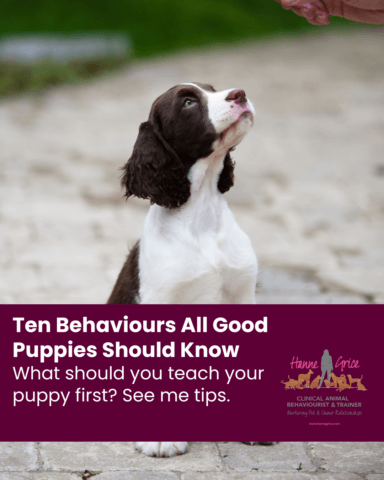
Here are my top 10 behaviours all good puppies should know.
1. Name recognition = eye contact: this is teaching your dog that when he hears his name, something brilliant follows (like a tasty treat or the opportunity to play with his most favourite toy). This helps with focus and attention on the owner, especially important when there are distractions around! Test this out yourself by calling your dog’s name and watching what he does. If your dog makes eye contact with you, immediately praise and reward them with whatever they adore. Once you have a reliable response, why not build on the duration of their eye contact – to make this more comfortable for your dog, make sure you smile, keep your eyes soft, and give them positive feedback to make this eye contact less intense for your pooch.
2. Hand target: a great way to teach your dog that hands equal lovely things! It helps reduce stress with handling, and teaches your dog to follow or target your hand – useful for recall, heeling and position training (such as sit, down and stand), as well as learning new tricks.
 3. Sit: think of it as the canine equivalent of saying “please”. Most dogs learn this request really quickly, so use it for all manner of things, including saying “hello” when you come in from work. This encourages your pooch to keep all four paws on the floor rather than jumping up at you. In fact, if you practice enough, you should be able to pair the word “hello” with an automatic ‘sit’ from your dog, making for a super polite pooch. Avoid repeating verbal cues, as this can cause dog frustration. Reward your dog whilst they remain in the sit position.
4. Down; this is another position in your doggie etiquette ‘toolbox’. The down position is useful for handling and will help you progress to various tricks, such as a roll over. But it can also be a lifesaver, too. For example, your dog can perform a drop-down while running if they are heading towards a road. In these instances, it may be easier for the dog to perform a great ‘down’ than to recall away from the distraction.
5. Stay: this can be used in a number of situations – whether that’s to avoid your dog racing out of the front door if you’re popping back and forth with shopping, or getting them to remain in a stay when a child is whizzing past on a bicycle. To teach a ‘rock solid’ stay, you’ll need to build, little by little, the duration of the stay, the distance, and the number of distractions around your dog. There are three positions for the stay: sit, stand, or down. When starting out with the stay, use the position your dog performs best in to set them up for success. Once your dog understands that “stay” means remaining on the spot, you can progress to teaching them this request in other positions.
 6. Leave it / take it: this is where the dog doesn’t go near the ‘thing’ that is within their reach. An extremely important life skill to have taught and use if you’re walking in the countryside surrounded by rabbit poop, or there’s a snotty tissue on the ground! The ‘leave it’ and ‘take it’ is all about teaching impulse control, something that puppies are not born with and have to be taught, much like children – and some adults. 🙂
7. Drop: according to the Hospital Episode Statistics, the majority of dog bites to adults are to the hands, often as a result of the person attempting to physically remove an item from the dog’s mouth. Unless the puppy’s environment is well managed, there will be occasions when a young dog is likely to pick up something you’d rather they didn’t have. So, having a reliable ‘drop’ is vital as it can avoid such confrontations in the first place. It’s also a useful behaviour to teach when playing with your dog, after all, if your dog won’t return and drop the toy, the game cannot continue!
8. Recall: teaching this request is a no-brainer. From being able to call your dog from one room to another to recalling them from play with another dog, the list of examples is endless. When first training a recall request, remember to be clear on your vocal and visual cue (for example, “Fido, come” paired with a hand target), then immediately praise and reward them for coming. Until the behaviour is acquired and well generalised, reinforce every single time the dog comes when called, and keep the dog on a long line. Never call your dog if you’re going to provide an unpleasant consequence (such as putting them in the bath, or loading them into the car boot if they find these things worrisome). And during the early stages of learning, give the recall cue only if your dog is likely to respond. This means avoid calling your dog when his head is down, sniffing/having a wee or poo, or about to have a difficult social interaction. As with all the behaviours discussed, it’s important you teach recall in a quiet area (like your house and garden) first. Once you’re getting a reliable response from your puppy, proof it, then progress onto introducing some distractions and repeat the process. Eventually, you should find that you are successfully recalling your dog in a highly distracting environment. See below for an example of a recall in the park with mild distractions (including interesting smells, birds, children playing behind me, and building work on a nearby house).
9. Loose lead: walking to heel can be one of the most challenging behaviours for owners to teach their dogs, because puppies are easily distracted, excitable and/or can be cautious when outside and attached to a lead. This is where patience, practice and consistency are key. Take advantage of the fact that puppies can’t walk for long periods because their joints, bones, and muscles are still developing. Instead, focus on teaching your dog where you want them to be, which is by your side. Think quality [of the walk], not quantity [number of miles you’re walking]. Never jerk the lead back to correct your dog’s position or drag them to you. It’s likely to hurt the dog and teaches them you are unpredictable and the sudden pain/discomfort and startle of the jerk can be accidentally paired with the trigger, such as the passing jogger or dog, which risks your dog then being worried about joggers or other dogs. This can then escalate to lunging and barking – so avoid punishment-based training and focus on reinforcement-based methods. If you’re stuck in a rut with this one, get in touch, or do enlist the help of a certified trainer – see the Animal Behaviour & Training Council’s Practitioner Directory for a list of professionals near you.
10. Go to bed & settle down: a useful request to teach your dog as this can be used when you have to go and answer the door, if you accidentally drop something or, in my case, when the baby needs a nappy change, and you want the dog away from the area. In the video example, you’ll see Nelly settle on her favourite sleeping and resting place – her sheepskin rug. You can use this request anywhere, but it helps if you have a visual marker to target where you want your dog to go (like their bed, rug or blanket) to set them up for success. Having a visual marker like a rug or blanket can then be easily transported from location to location, such as a friend’s house, the pub and so on, acting as a clear marker of where you want your pup to rest. Check out my pub dog training guide here.
Happy training!
Learn more about our classes
Get Hanne's book, clothing and more
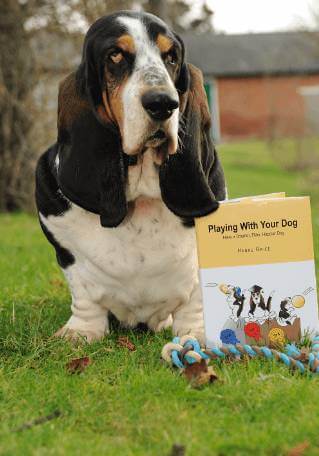
Hanne has a number of publications including her book Playing With Your Dog to help owners work out the games that are best suited for their pet to play throughout his life, from puppyhood to old age, available from Amazon. Check out Hanne's range of contemporary casuals The Collection – for pet lovers made from recyclable, organic materials that are sustainably sourced.