Checking ears, brushing a coat, or examining teeth can be challenging when a dog finds handling uncomfortable and may escalate into growling and snapping. Cooperative care involves teaching our dogs to actively participate in their own grooming, veterinary exams, and overall health maintenance. A chin rest, also called a chin target, involves your dog voluntarily placing their chin on your hand or another suitable surface.
We can then gradually introduce handling while they rest their chin. If they lift their head or move their head away, we pause. This gives them a way to start the interaction and take a break, provided we consistently respond to their signal.
Why is the chin rest so valuable?
Here are a few key benefits:
- A familiar starting point. A chin rest gives you and your dog a familiar behaviour to build on. You can begin at home, introducing brief, gentle touches and pairing these with something your dog enjoys, such as a food reward. Each part of grooming or examination needs its own preparation, from a hand approaching an ear to the sight and sound of equipment.
- Helping with health checks: The position can help with certain checks around the head. While lifting lips, opening the mouth and examining ears need separate training, once taught, utilising the chin rest can enable you, your groomer or vet to inspect these areas which may reduce the need for restraint during some checks, depending on your dog’s comfort and the procedure.
- Clearer communication: Your dog will soon learn that when lifting their chin reliably pauses the handling, they have a way to influence what happens. This low-stress handling can help you better recognise the more subtle signs of when your dog is feeling unsure or needs a break. Watch the rest of their body too, and if they tense, freeze, hold their breath, or their breathing changes, pause even if their chin stays on the target. Consequently, cooperative care gives dogs…
- A chance to participate: Dogs have the opportunity to approach, take part and step away during practice at any point. How quickly they progress will depend on their health, previous experiences and what we are asking them to cope with.
What does the research tell us?
Research into training for veterinary care is still developing. Stellato and colleagues (2019) found modest improvements in some measures of veterinary fear after four weeks of gradual handling practice and visits to the clinic. Several other measures remained unchanged. Wess and colleagues (2022) found mixed results following a cooperative-care programme, and the trained skills transferred poorly into the veterinary examination. Their study used a front-paw target, rather than a chin rest.
This highlights the need to ensure that any cooperative care is practised across contexts, including the veterinary setting, and progressed systematically, at your dog’s pace, to help your dog become comfortable with the handling in each setting. Otherwise, what we think we have taught our pets may not be the case at all. So, there is reason to practise, while keeping expectations realistic. We need to prepare dogs for the people, places and procedures they will encounter.
Getting started
Use small pieces of food your dog can tolerate and enjoys, with a marker such as a clicker or a verbal “yes” to identify the behaviour you are rewarding. Praise can be included if your dog enjoys it.
Practise somewhere quiet and familiar, with secure footing. Keep sessions short and work at your dog’s pace.
- Choose a target, such as your hand or a stable, padded surface. Position it so your dog can rest their chin comfortably, without stretching or bending awkwardly.
- Reward small steps towards chin contact. Allow your dog to move towards the target themselves. Never place or hold their head in position.
- Build duration gradually. Mark and reward brief contact first. Your dog can lift their head to collect the food.
- Introduce a tiny handling step. Once the chin rest is familiar, try a brief touch to an area your dog is already comfortable having touched. If they lift their chin, stop the touch.
- Change one thing at a time. Longer contact, a different person, a new location and equipment each need practice. Return to an easier step whenever needed.
Always keep an eye out for any tension, freezing, turning away, pulling back or attempts to leave. Consider the context in which you are practising; watch your dog’s whole body language, because taking food or staying still alone cannot tell us whether they are comfortable. Never use food to keep them in position while continuing handling they find unpleasant.
Watch: Diary of a Chin Target
My Diary of a Chin Target shows how to introduce the behaviour. Watch alongside the steps above, allowing your dog time to learn. Teaching the target comes first; preparation for handling and equipment follows gradually.
Before using it at the vets
Talk to your veterinary team about what your dog has learned. Agree on how the chin rest will be used and what will happen when they lift their head. Some procedures cannot safely stop immediately, so these need a separate plan.
Training takes time, and your dog may need care before they are ready. Your vet can advise on pain relief, anxiety medication or sedation where appropriate. These can help protect your dog’s welfare and everyone’s safety.
If handling seems painful, or your dog’s tolerance changes, seek veterinary advice. For dogs who are frightened by handling or may bite, get professional support before practising these exercises. Seek guidance from an appropriately qualified trainer or clinical animal behaviourist for a training plan tailored to your dog’s needs. Check out the Animal Behaviour and Training Council’s website for a list of registered practitioners.
Here’s a little snippet of Hattie and me waiting to be seen at the vet’s. We had practised this together beforehand, so it was familiar to her at the clinic.
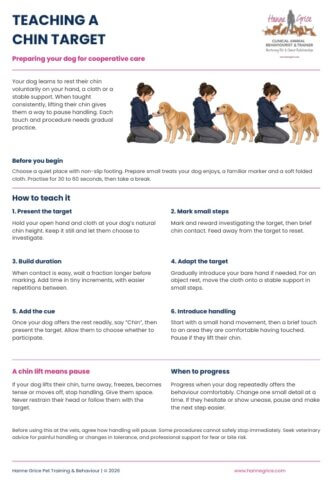
Want the steps to hand while you practise?
Download my Teaching a Chin Target handout, with reminders on introducing the behaviour, recognising when to pause and deciding when to progress.
Download the chin-target training guide (PDF)
Further reading
For practical guidance, check out resources including but not limited to “Cooperative Care: Seven Steps to Stress-Free Husbandry” by Deborah Jones PhD and “Don’t Shoot the Dog!” by Karen Pryor. These books provide further reading on learning and reinforcement
References
- Riemer, S. et al. (2021). A Review on Mitigating Fear and Aggression in Dogs and Cats in a Veterinary Setting. Animals, 11(1), 158.
- Stellato, A., Jajou, S., Dewey, C. E., Widowski, T. M. and Niel, L. (2019). Effect of a Standardized Four-Week Desensitization and Counter-Conditioning Training Program on Pre-Existing Veterinary Fear in Companion Dogs. Animals, 9(10), 767.
- Wess, L. et al. (2022). Effect of cooperative care training on physiological parameters and compliance in dogs undergoing a veterinary examination: A pilot study. Applied Animal Behaviour Science, 250, 105615.
Learn more about our classes
Get Hanne's book, clothing and more
Hanne has a number of publications including her book Playing With Your Dog to help owners work out the games that are best suited for their pet to play throughout his life, from puppyhood to old age, available from Amazon. Check out Hanne's range of contemporary casuals The Collection – for pet lovers made from recyclable, organic materials that are sustainably sourced.