
Closeness is one of the most visible behaviours in the human-dog relationship. Many guardians use it as a yardstick for bond strength, assuming that the dog who follows everywhere must feel deeply connected. Behaviour is easier to observe than emotion. Yet proximity is a blunt measure. It tells us where a dog is, not how they feel.
The Proximity Paradox in dogs describes how closeness can carry different meanings in different emotional states.
Attachment in dogs has been explored using adapted versions of Ainsworth’s Strange Situation Procedure, showing that many dogs display attachment behaviours towards their caregiver, including proximity seeking and reunion responses. Research has also demonstrated that caregivers can function as a secure base, supporting a dog’s willingness to explore, and as a safe haven during challenge. Together, these findings suggest that security is expressed through flexibility, not constant closeness.
What secure attachment looks like in dogs
This is where the proximity paradox emerges. The same behaviour, staying close, can reflect comfort in one context and difficulty coping in another. Attachment researchers distinguish between attachment behaviours observed in the moment and the attachment bond expressed across situations and time. In everyday conversations, these ideas are often blurred, which is where misinterpretations arise.
Independence is better understood as capacity rather than character. Learning history, predictability of care, and past experiences of separation shape whether distance feels safe or threatening. Secure-base functioning predicts that a dog can engage with their environment, rest away from their caregiver, and return when needed. In daily life, this may appear as a dog choosing a resting spot across the room, remaining settled when their person moves around the home, or exploring briefly before checking back in. These behaviours are consistent with emotional security, though they are not, on their own, a formal attachment assessment.
When closeness signals coping rather than comfort
Context matters. Pain, physical discomfort, and accumulated stress can alter attention, coping, and social behaviour. Clinical research highlights that pain is frequently involved in behaviour change in dogs, sometimes as a primary driver and often as an amplifier of existing difficulty. When emotional load increases, many dogs shift towards greater proximity seeking and reliance on familiar social support.
Rather than asking whether a dog wants to be near their person, a more useful question is whether they have the option to be away and still feel safe. This reframes the conversation away from labels such as clingy or needy and towards welfare, regulation, and coping capacity.
Supporting healthy flexibility often involves small, repeatable experiences. Comfortable resting spaces placed a short distance away, calm enrichment that encourages settling, and allowing a dog to potter off without being called back all contribute to a sense of safety with distance. Over time, these moments build evidence for the dog that space does not threaten connection.
🧬 Learn more with my episode, the Proximity Paradox. Click here to watch the Science of Connection playlist.
References
- Gácsi, M., Maros, K., Sernkvist, S., Faragó, T. and Miklósi, Á. (2013) Human analogue safe haven effect of the owner: behavioural and heart rate response to a threatening social stimulus in dogs. PLOS ONE, 8(3), e58475.
- Horn, L., Huber, L. and Range, F. (2013) The importance of the secure base effect for domestic dogs: evidence from a manipulative problem-solving task. PLOS ONE, 8(5), e65296.
- Mills, D.S., Demontigny-Bédard, I., Gruen, M. et al. (2020) Pain and problem behavior in cats and dogs. Animals, 10(2), 318.
- Palmer, R. and Custance, D. (2008) A counterbalanced version of Ainsworth’s Strange Situation Procedure reveals secure-base effects in dog–human relationships. Applied Animal Behaviour Science, 109(2–4), 306–319.
- Parthasarathy, V. and Crowell-Davis, S.L. (2006) Relationship between attachment to owners and separation anxiety in pet dogs. Journal of Veterinary Behavior, 1(3), 109–120.
- Rehn, T. and Keeling, L.J. (2016) Measuring dog–owner relationships: crossing boundaries between animal behaviour, human psychology and science. Applied Animal Behaviour Science, 185, 1–8.
- Topál, J., Miklósi, Á., Csányi, V. and Dóka, A. (1998) Attachment behavior in dogs: a new application of Ainsworth’s Strange Situation Test. Journal of Comparative Psychology, 112(3), 219–229.
Learn more about our classes
Get Hanne's book, clothing and more
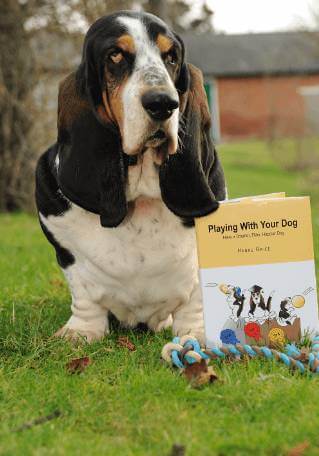
Hanne has a number of publications including her book Playing With Your Dog to help owners work out the games that are best suited for their pet to play throughout his life, from puppyhood to old age, available from Amazon. Check out Hanne's range of contemporary casuals The Collection – for pet lovers made from recyclable, organic materials that are sustainably sourced.