When people describe behaviour concerns in dogs or cats, labels tend to appear quickly: reactive, aggressive, anxious. These words help humans make sense of what they are seeing, particularly when behaviour feels confusing, stressful, or emotionally charged. From a psychological perspective, this is entirely predictable. Humans categorise to reduce complexity, using labels as cognitive shortcuts to organise information and decide what to do next.
The difficulty arises when the label begins to stand in for explanation.
Behaviour does not exist as a fixed trait that an animal simply possesses. It emerges through interaction, shaped by learning history, environment, physiology, and the social context in which the animal lives. For companion animals, that social context is overwhelmingly human. Dogs and cats do not choose their routines, the predictability of their days, or the way resources are accessed. They adapt to the systems we place them in. This functional view of behaviour, which prioritises context, learning, and welfare over traits or blame, sits at the heart of clinical behaviour assessment (Overall, 2013; Mills, 2017).
This is where focusing solely on the animal becomes misleading.
Dogs, having lived alongside humans for thousands of years, typically show behaviour that is highly sensitive to human attention, proximity, and emotional cues. Changes in tone, posture, movement, or routine can be enough to alter how safe or predictable a situation feels, and dogs often respond with behaviours that are obvious and difficult to ignore, such as barking, growling, lunging, pacing, or snapping.
Cats, while equally capable of forming social bonds, often communicate discomfort or uncertainty in more understated ways. A cat may withdraw rather than escalate, feign rest or sleep, freeze in place, increase time spent out of sight, or show subtle changes in body tension long before more overt behaviour appears, such as fighting with another cat or urinating around the home. Where health-related factors have been considered, these responses are easily overlooked, particularly in busy households, yet they serve the same function as a dog’s more visible signals. They are attempts to cope within the constraints of the environment.
In both species, behaviour that humans experience as problematic is rarely arbitrary. It reflects how the animal has learned to navigate their world, what has previously worked to reduce pressure, and what information is available to them in that moment. Clinical and welfare-oriented behaviour science consistently demonstrates that human responses, routines, and expectations shape learning processes and emotional associations over time (Overall, 2013; Mills, 2017).
This is why attempts to change behaviour rarely succeed without considering the human side of the system.
You may often hear animal professionals talk about behaviour change being rarely linear. That observation reflects how learning actually works. Progress fluctuates because environments fluctuate. Human expectations, emotional states, timing, and consistency all shift, often without intention. Animals respond to those shifts, adjusting their behaviour in line with what feels safest, most predictable, or most effective at the time.
Work examining human-animal relationships shows that interactions are shaped by emotion, expectation, and context on both sides of the relationship, influencing behaviour and learning processes across species (Payne et al., 2015). This does not suggest that humans cause behaviour problems. Rather, it highlights that behaviour develops within a shared system, one in which human actions and emotional states are always part of the picture.
Understanding pet behaviour through this lens moves us away from blame and towards something far more useful. For pet owners and guardians, it reframes behaviour as neither a personal failing nor evidence of an animal being difficult, dominant, or broken. Behaviour is information. It reflects how an animal is coping within the world they are living in, and within the expectations placed upon them.
For professionals, this perspective is equally important. Behaviour change is often discussed as something that happens to animals, through training plans, management strategies, or enrichment protocols. Yet meaningful change rarely occurs when attention remains fixed on the animal alone. It emerges when we also examine the human side of the system, including expectations, consistency, emotional responses, routines, and the pressures that shape everyday interactions. For professionals, this perspective aligns with established behaviour change models increasingly applied within animal behaviour practice (Grice and Hughes, 2023).

When humans adjust how they interact, how environments are structured, and how learning opportunities are presented, animals receive clearer and more predictable information about what is safe, what is expected, and what options are available to them. That clarity reduces the need for behaviours rooted in avoidance, defence, or heightened arousal. Behaviour becomes more flexible not because the animal has been fixed, but because the conditions influencing behaviour have changed.
This applies as much to cats as it does to dogs. Whether behaviour presents as withdrawal, heightened vigilance, reactivity, or frustration, the underlying processes develop within a shared human-animal system in which behaviour develops over time. Behaviour change, in its most sustainable form, is not about exerting control over animals. It is about understanding how learning, emotion, and environment interact across species.
Seen this way, behaviour cannot be separated from the people involved. It develops through relationships, routines, and responses over time. When we recognise that humans are always part of that process, we create space for change that is realistic, ethical, and long-lasting.
References
- Grice, H. (2015) Stress in dogs – what we can’t see. Available at: Stress in dogs – what we can’t see – Hanne Grice Pet Training & Behaviour
- Grice, H. (2024) Empathy Improves Understanding of Human and Dog Emotions. Available at: Empathy Improves Understanding of Human and Dog Emotions – Hanne Grice Pet Training & Behaviour
- Grice, H. (2024) Stress, trauma and the body. Available at: Stress, trauma and the body – Hanne Grice Pet Training & Behaviour
- Grice, H. (2024) The Social Brain and Animals. Available at: The Social Brain and Animals – Hanne Grice Pet Training & Behaviour
- Grice, H. and Hughes, L. (2023) Human behaviour change for animal professionals. Professional education course. Available at: https://learn.hannegrice.com/products/courses/view/1146549
- Mills, D.S. (2017) ‘Perspectives on assessing stress and welfare in animals’, Journal of Veterinary Behavior, 19, pp.1-6. doi.org/10.1016/j.cobeha.2017.04.002
- Overall, K.L. (2013) Manual of Clinical Behavioral Medicine for Dogs and Cats. St. Louis: Elsevier.
- Payne, E., Bennett, P. and McGreevy, P. (2015) ‘Current perspectives on attachment and bonding in the dog–human dyad’, Psychology Research and Behavior Management, 8, pp.71-79. doi: 10.2147/PRBM.S74972
Learn more about our classes
Get Hanne's book, clothing and more
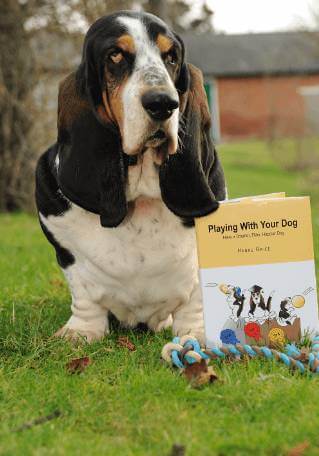
Hanne has a number of publications including her book Playing With Your Dog to help owners work out the games that are best suited for their pet to play throughout his life, from puppyhood to old age, available from Amazon. Check out Hanne's range of contemporary casuals The Collection – for pet lovers made from recyclable, organic materials that are sustainably sourced.