That first week with a new puppy feels magical. Every wobbling sit and over-excited leap reminds you why dogs have shared our lives for millennia. Yet, beneath all the excitement, those early weeks are critical for shaping your dog’s confidence, focus, and behaviour for years to come. Choosing the right class from puppyhood to adolescence, can set the path towards a calm, well-mannered companion who enjoys learning – or a confused youngster who struggles to cope with the world around them.
Why your class choice matters
Modern training is rooted in learning, communication, and emotional safety. A well-run class teaches your dog how to settle, listen, and respond calmly around distractions. It also teaches you how to interpret their body language, support their emotions, and reward the behaviours you want to see more of.
Some classes, however, still use old-fashioned notions of “pack leadership” or dominance. These suppress behaviour rather than explain it and can increase stress, frustration, or fear (Ziv, 2017). A good class focuses on trust, not control.
What a good class looks like

When searching for a class, check for these essentials:
- Qualified, accredited professionals you can trust: Look for professionals listed with the Animal Behaviour and Training Council (ABTC). ABTC accreditation means they meet the role standards – criteria relating to welfare, and they have been independently and rigorously assessed for having the necessary knowledge, understanding, and practical skills to work at the level they advertise.
- Small, structured groups: Fewer dogs mean calmer learning, more attention, and space to practise safely.
- Clear teaching & reward-based methods: Trainers should explain, demonstrate, and support each partnership without judgement and utilise reward-based methods for both the dogs and their handlers.
- Emotional awareness: Great training builds confidence and resilience, rather than compliance through fear.
- Appropriate content: Puppies need socialisation and gentle introductions; teenagers need focus and self-control; adults may need to unlearn habits. A great class is progressive, provides clarity and makes suitable adjustments for the dogs and handlers when needed.
If a class talks about “being alpha”, “showing who’s boss”, suggests the use of choke chains, pet corrector sprays, lead corrections, the trainer spends more time talking about their achievements than focusing on teaching new behaviours, or blames the owner for being “too soft” – it’s time to walk away. Over the years, I have heard many strange yet true stories, including one client that turned up to her first puppy class with an extendable lead and was promptly made to perform push-ups in front of the class. Humiliated, my client promptly walked away and joined our Puppy & Dog School. She went on to achieve great success with her dog.
The science of kind training
Research in learning theory, neuroscience, and animal welfare consistently shows that dogs trained through positive reinforcement learn faster and retain skills longer (Vieira de Castro et al., 2020). Reward-based teaching strengthens the bond between guardian and dog, encourages curiosity, and supports emotional stability.
Deldalle & Gaunet (2014) found that dogs trained using “traditional” aversive methods spent less time making eye contact with their handler – a key behaviour associated with oxytocin release and bonding – than dogs trained in reward-based classes. Those taught with punitive techniques also displayed significantly more stress-related behaviours such as lip-licking, yawning, and gaze avoidance. In contrast, dogs in science-led, positive-reinforcement classes showed calmer body language and greater engagement with their handlers.
Similarly, Nagasawa et al. (2015) demonstrated that mutual eye contact between dogs and their guardians triggers oxytocin release in both species, strengthening trust and attachment. When dogs feel safe, dopamine-based reward circuits support calm focus and learning, consistent with how reward prediction signals drive acquisition and retention (Schultz, 2015).
These physiological and behavioural findings reinforce why professional organisations such as the British Small Animal Veterinary Association (BSAVA) and the Animal Behaviour & Training Council advocate reward-based methods as the humane, effective, and evidence-backed standard.
Beyond sit and stay
Training should prepare dogs for everyday life. Key life skills include:
- Coming when called
- Walking calmly on lead
- Ignoring food/dropped items on pavements
- Greeting politely
- Learning to cope with novel situations
- Relaxing on a mat or bed
- Focusing amid distractions
- And other behaviours that support the animal and build resiliency
These build confidence, predictability, and harmony at home and on walks. They also create a shared language between you and your dog – one based on choice and trust. If you find a class, speak to the trainer[s] and ask if you can pop by to watch, as this will give you a feel for how the classes run and the methodology used in class. Observe the handlers and dogs, consider if they look comfortable and they are encouraged and supported by the instructor[s]. If someone or a dog is struggling, how does the instructor respond?
What sets my classes apart
At my Puppy & Dog School in Tring, every session blends practical science with empathy and fun. Classes are small, structured, and supportive. Each guardian receives clear guidance and follow-up materials to keep progress steady.
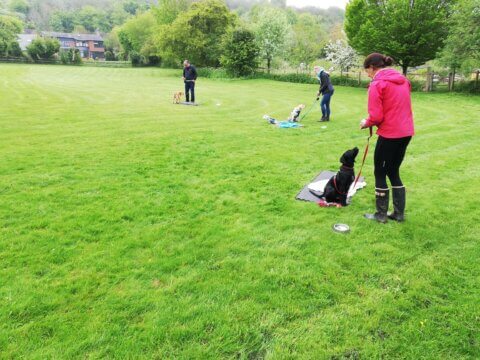
As an ABTC-accredited Clinical Animal Behaviourist and certified trainer, I consider emotional, medical, and environmental factors in every plan. The result is a more confident, relaxed dog and a guardian who understands why their dog behaves as they do. Our courses progress from Puppy, Teens, to Stage 3, each designed for the dog’s developmental stage and guardian goals.
“The dogs leave more confident, and the owners leave more informed.”
Classes run at Nora Grace Hall and Hastoe Village Hall, with access to both indoor and outdoor areas. Check out our reviews on Facebook, Google and Testimonials for more – our training and behaviour support has been trusted since 2006.

How to book
Bookings are now open for the winter term. View upcoming dates and reserve your space on the Puppy & Dog School page. If you’re unsure which class suits your dog, get in touch – I’ll help you find the right fit.
For help understanding when to work with a trainer and when clinical behaviour support may be needed, see my article on visit Understanding Dog Trainers And Behaviourists – Differences, Overlaps & More.
References
- British Small Animal Veterinary Association (BSAVA), 2023. Aversive Training Methods. Available at Aversive training methods | BSAVA
- Deldalle, S., and Gaunet, F. (2014) Effects of 2 training methods on stress-related behaviors of the dog (Canis familiaris) and on the dog–owner relationship. Journal of Veterinary Behavior: Clinical Applications and Research. 9(2), pp.58-65. Available at: https://www.sciencedirect.com/science/article/abs/pii/S1558787814000070
- Nagasawa, M., Mitsui, S., En, S., Ohtani, N., Ohta, M., Sakuma, Y., Onaka, T., Mogi, K. and Kikusui, T. (2015) Oxytocin-gaze positive loop and the coevolution of human–dog bonds. Science. 348(6232), pp.333-336. https://doi.org/10.1371/journal.pone.0225023
- Schultz, W. (2015) Neuronal reward and decision signals, from theories to data. Physiological Reviews. 95(3), pp.853–951. https://pmc.ncbi.nlm.nih.gov/articles/PMC4491543/
- Vieira de Castro, A.C., Fuchs, D., Morello, G.M., Pastur, S., de Sousa, L., Olsson, I.A.S. (2020) Does training method matter? Evidence for the negative impact of aversive-based methods on companion dog welfare. PLoS ONE. 15(12): e0225023. https://doi.org/10.1371/journal.pone.0225023
- Ziv, G. (2017) The effects of using aversive training methods in dogs—A review. Journal of Veterinary Behavior. 19, pp.50-60. https://doi.org/10.1016/j.jveb.2017.02.004.
Learn more about our classes
Get Hanne's book, clothing and more
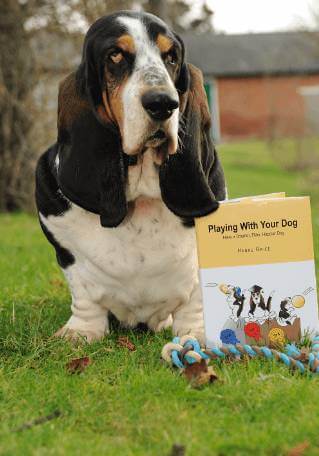
Hanne has a number of publications including her book Playing With Your Dog to help owners work out the games that are best suited for their pet to play throughout his life, from puppyhood to old age, available from Amazon. Check out Hanne's range of contemporary casuals The Collection – for pet lovers made from recyclable, organic materials that are sustainably sourced.