
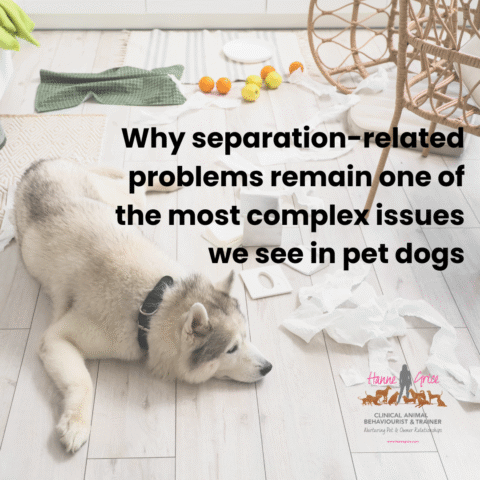
Separation-related problems make up a significant proportion of the dogs I see in clinical practice. Over years of working with these cases, clear patterns emerge. Dogs who struggle when left alone, often labelled separation-related problems or separation anxiety, rarely show just one behaviour in isolation. More often, the cases I see sit within a wider picture of anxiety traits, developmental stage shifts, routine changes, health factors, and changes within the human-animal relationship itself.
A recent qualitative study by Almquist et al. (2026) published in Scientific Reports explores these same patterns from a different angle. Instead of measuring dogs directly or relying primarily on owner reporting, the researchers interviewed experienced dog professionals, including trainers, veterinarians, and behaviourists from Denmark, Sweden, and Norway, asking what they consistently observe across separation-related cases. The findings provide something behaviour science often struggles to capture, which is the texture of real-world clinical experience.
Hence, this latest research helps build a clearer picture of what animal professionals consistently observe in dogs with separation-related problems, and what this means for assessment, treatment, and real-life support for dogs who become distressed when left alone.
What the study found…
Across professional interviews, several recurring themes emerged:
- Dogs with SRPs often showed other anxiety-linked behaviours, especially noise sensitivity or generalised environmental anxiety
- Developmental stage matters – adolescence appeared frequently in case histories
- Training history sometimes featured, particularly inconsistent or high-stress learning experiences, including punishment-based methods, although cause and effect remained unclear
- Certain breed types appeared more often in referral populations, although individual variation remained significant
- Changes in routine, environment, or household structure often appeared before onset or escalation of SRPs
- The emotional relationship between dog and guardian appears closely linked to how SRPs develop and continue
The findings highlight that separation-related problems rarely occur in isolation; rather, they reflect how well a dog can cope emotionally when multiple pressures converge. Download the infographic findings here.

The study’s findings alongside the wider science
Large-scale population studies already show a strong overlap between anxiety presentations in dogs (Salonen et al., 2020). For example, research exploring fear and frustration responses in everyday situations, such as reactivity to dogs, heightened responses to visitor arrivals, difficulty settling, or persistent arousal states, is also closely linked to separation-related behaviours.
There is also growing evidence that dogs and humans influence each other’s stress levels over time. This supports what many clinicians observe, guardian anticipation around leaving, tension during departure routines, or inconsistent return timing can become part of the dog’s learning environment. So, rather than introducing a completely new theory, this study highlights how often these factors cluster together in real cases that I and many of my peers deal with.
This is also where the research overlaps with ideas explored in my Science of Connection video series, particularly episodes looking at the oxytocin loop, cortisol and stress communication, and how safety is signalled within human-animal relationships. That is because separation-related problems often sit at the intersection of these systems.
Some considerations with this new study…
While Almquist et al.’s (2026) study reflects professional experience, it does not account for direct behavioural or biological measurements. Although it provides depth and real-world context, it also introduces the potential for bias, as animal professionals’ responses are shaped by their training backgrounds, referral populations, and regional dog culture.
The sample size is small, and Nordic dog ownership patterns differ from UK norms in some routine and lifestyle areas. These findings are best understood as informed clinical observations rather than universal biological rules.
The training theme also requires nuance. Once a problem appears, humans naturally look backwards for explanations. Some dogs may simply be more sensitive to poorly timed or high pressure learning experiences rather than training history acting as a primary cause.
So what does this mean for dogs with separation-related problems and their guardians?
Separation-related problems are more often about coping capacity. Evidence-informed clinical behaviour practice increasingly focuses on:
- Checking for pain/discomfort and sleep disruption early
- Looking at the dog’s full emotional profile, rather than solely the behaviour exhibited when left alone
- Supporting predictable routines and clear departure patterns
- Avoiding accidental reinforcement cycles linked to return timing and unplanned absences
- Recognising critical stages of development like adolescence, as a period that can amplify existing vulnerabilities
Dogs experiencing separation-related problems, whether that shows up as vocalising, destruction, or toileting when left alone, are often navigating a nervous system under pressure, rather than making deliberate behavioural choices in the way humans sometimes assume. Stability, predictability, and emotionally safe learning experiences sit at the centre of effective support.
Need help with your pet?
If you are experiencing separation-related problems with your pet, please get in touch at [email protected], or search for a registered Clinical Animal Behaviourist via the Animal Behaviour & Training Council (ABTC) Practitioners Directory.
References
- Almquist, E., Meyer, I., Sandøe, P., Thomassen, K.M., Newberry, R.C. and Rehn, T. (2026) Professional perspectives on recurrent characteristics of dogs with separation-related problems: a qualitative study in three Nordic countries. Scientific Reports, 16, Article 36791. Available at: https://www.nature.com/articles/s41598-026-36791-w
- Salonen, M., Sulkama, S., Mikkola, S., Puurunen, J., Hakanen, E., Tiira, K., Araujo, C. and Lohi, H. (2020) Prevalence, comorbidity and breed differences in canine anxiety in 13,700 Finnish pet dogs. Scientific Reports, 10, Article 2962. Available at: https://www.nature.com/articles/s41598-020-59837-z
- Sundman, A.S., Van Poucke, E., Svensson Holm, A.C., Faresjö, Å., Theodorsson, E., Jensen, P. and Roth, L.S.V. (2019) Long-term stress levels are synchronised in dogs and their owners. Scientific Reports, 9, Article 7391. Available at: https://www.nature.com/articles/s41598-019-43851-x
- Lenkei, R., Faragó, T., Bakos, V. and Pongrácz, P. (2021) Separation-related behaviour of dogs shows association with their reactions to everyday situations that may elicit frustration or fear. Scientific Reports, 11, Article 19207. Available at: https://www.nature.com/articles/s41598-021-98526-3
Learn more about our classes
Get Hanne's book, clothing and more
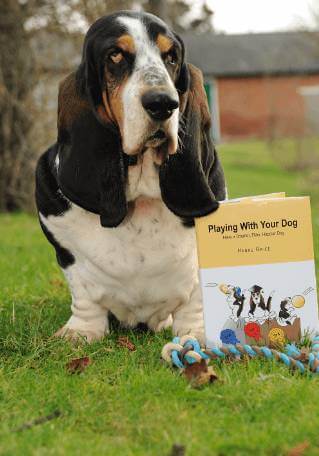
Hanne has a number of publications including her book Playing With Your Dog to help owners work out the games that are best suited for their pet to play throughout his life, from puppyhood to old age, available from Amazon. Check out Hanne's range of contemporary casuals The Collection – for pet lovers made from recyclable, organic materials that are sustainably sourced.