
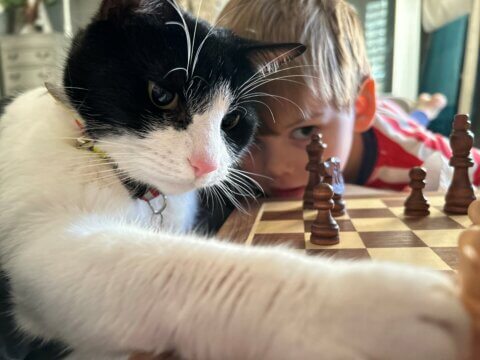
Cats and children can share rich, affectionate relationships. In my own household, as in many others, carefully supported interactions have allowed cats and children to build close and trusting bonds. Yet structured guidance on cat-child interactions remains limited, particularly when compared with the more established body of research exploring dogs and children. As a result, families often approach pregnancy, infancy, and early childhood with cats relying on instinct rather than evidence-informed planning.
In clinical animal behaviour practice, I have seen a growing number of families seeking support during pregnancy and after the arrival of a baby. My earlier research and professional work in human-animal interactions has largely focused on peri partum relationships with dogs. Increasingly, similar questions are now being raised by cat owners and guardians, including how to prepare cats for a baby, how to prevent stress or injury, and how to support stable relationships as children grow. This rising demand highlights the need for clearer, evidence-informed guidance for families living with cats during early parenthood.

What evidence exists, and where gaps remain
Direct empirical research linking specific child developmental stages to feline behavioural outcomes remains limited. To this author’s knowledge, no peer-reviewed study has yet mapped child age stages to feline behavioural risk in the way Love and Overall’s 2001 developmental model did for dogs. The framework presented here adapts that structure for cats by bringing together established paediatric developmental knowledge with peer-reviewed research on feline welfare, stress, and handling, alongside clinical behavioural practice. The table, therefore, offers a structured way to anticipate likely interactions between children and cats, rather than claiming experimentally proven age-specific outcomes.
Download the framework ‘Development stages of infants and children and potential impacts on domestic cats’, below.
Reading the cat in front of you
Cats communicate discomfort long before they scratch or bite. Early signals such as ear rotation, head turning away, tail tip twitching, skin rippling, brief freezing, or withdrawal often precede overt defensive behaviour. Escalation may include hair raising (piloerection), growling, hissing, hard staring, or rapid flight.
Understanding these signals is central to preventing injury and protecting welfare. See my article on the Cat Ladder of Aggression, which illustrates how subtle signals progress when boundaries are missed.
Anticipating rather than reacting
Placing known feline behavioural responses alongside typical child development allows families and professionals to anticipate periods of increased risk rather than waiting for problems to emerge.
For example:
- New infant sounds, smells, and equipment may increase vigilance or withdrawal in some cats.
- Crawling and grasping behaviours can trigger flight or defensive responses if cats feel unable to escape.
- Toddler chasing or hugging may provoke stress or defensive behaviour when boundaries are not respected.
- Older children, when guided in consent based interaction, often develop stable, positive relationships with cats.
This developmental lens offers a practical tool for preventive planning rather than crisis management.
Implications for cats and children in the home
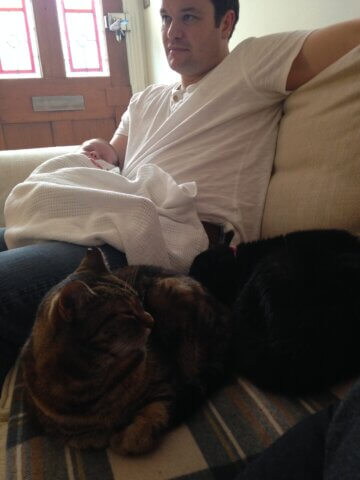
Cats rely on predictable environments and the ability to choose distance and contact to feel safe. As infants develop into mobile, curious children, those choices can become harder for cats to maintain, increasing the likelihood of stress or defensive behaviour. Preparing cats gradually for baby-related changes and teaching children respectful, consent-based interaction supports welfare and safety for both. Where concerns arise, or when families are expecting a baby, guidance from a certified feline behaviour practitioner can help ensure humane and secure outcomes, with UK-registered practitioners listed through the Animal Behaviour and Training Council and International Association of Animal Behavior Consultants for the rest of the world.
Supporting the cat’s environment and emotional needs is equally important. For practical guidance on enrichment and meeting feline environmental requirements, see my article here.
A starting point for future research
To this author’s knowledge, no previous publication has structured child developmental stages alongside feline behavioural risk in this way. This framework provides a foundation for preventive practice and highlights opportunities for future longitudinal research exploring cat-child relationships across development. Reflections and professional discussion are welcomed as understanding in this area continues to grow.
References
- Amat, M., Ruiz de la Torre, J.L., Fatjo, J., Mariotti, V.M., Van Wijk, S. and Manteca, X. (2009) Potential risk factors associated with feline behaviour problems. Applied Animal Behaviour Science, 121(2), pp. 134–139. https://doi.org/10.1016/j.applanim.2009.09.012
- Amat, M., Camps, T. and Manteca, X. (2016) Stress in owned cats: behavioural changes and welfare implications. Journal of Feline Medicine and Surgery, 18(8), pp. 577–586. https://doi.org/10.1177/1098612X15590867
- Ellis, S.L.H., Rodan, I., Carney, H.C., Heath, S., Rochlitz, I., Shearburn, L.D., Sundahl, E. and Westropp, J.L. (2013) AAFP and ISFM Feline Environmental Needs Guidelines. Journal of Feline Medicine and Surgery, 15(3), pp. 219–230. https://doi.org/10.1177/1098612X13477537
- Love, M. and Overall, K.L. (2001) How anticipating relationships between dogs and children can help prevent disasters. Journal of the American Veterinary Medical Association, 219(4), pp. 446–453. https://doi.org/10.2460/javma.2001.219.446
- Rodan, I., Sundahl, E., Carney, H., Gagnon, A.C., Heath, S., Landsberg, G., Seksel, K., Yin, S. and Westropp, J.L. (2011) AAFP and ISFM feline-friendly handling guidelines. Journal of Feline Medicine and Surgery, 13(5), pp. 364–375. https://doi.org/10.1016/j.jfms.2011.03.012
- Centers for Disease Control and Prevention (2023) Developmental milestones. Available at: https://www.cdc.gov/act-early/milestones/ (Accessed: insert date).
- NHS (2023) Early learning and development: Best Start in Life. Available at: https://www.nhs.uk/best-start-in-life/early-learning-development/ (Accessed: 5 December 2025).
- National Institute on Deafness and Other Communication Disorders (2023) Speech and language development milestones. Available at: https://www.nidcd.nih.gov/health/speech-and-language (Accessed: 5 December 2025).
Learn more about our classes
Get Hanne's book, clothing and more
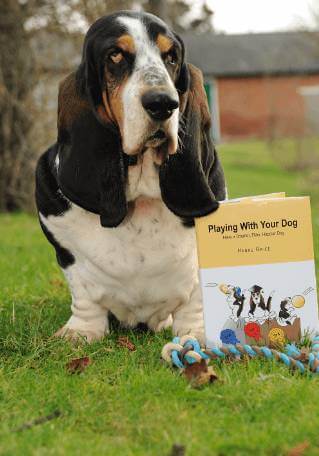
Hanne has a number of publications including her book Playing With Your Dog to help owners work out the games that are best suited for their pet to play throughout his life, from puppyhood to old age, available from Amazon. Check out Hanne's range of contemporary casuals The Collection – for pet lovers made from recyclable, organic materials that are sustainably sourced.