
“They can be lovely together, but then suddenly they fight. I don’t get it.”
A client said this to me the other day when seeking help for their cats, who were fighting yet still chose to be near one another and groom each other. They had assumed this meant the cats got on.
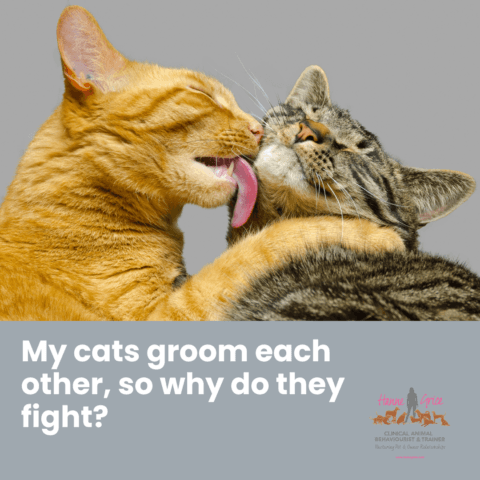
What does the science tell us?
A recent study by Van Belle et al. (2026) has looked at feline allogrooming (when one cat grooms another) in more detail. The researchers analysed interactions among 53 domestic cat pairs (106 cats in total). Using an ethogram of 23 behaviours, they examined what happened around grooming, including before and afterwards.
Their analyses identified two broad contexts. In one, grooming occurred alongside behaviours consistent with affiliation or social bonding. This included mutual physical contact-seeking and similar body postures, and was sometimes followed by mutual wrestling consistent with play. In another context, grooming occurred alongside social tension, including asymmetrical postures, ears rotated backwards, displacement behaviours such as lip licking or head shaking, and sometimes striking or biting.
The researchers suggest that grooming in these more tense interactions may sometimes act as appeasement or as a subtle agonistic signal. In some interactions, the cats separated afterwards, and the groomer gained access to a desired resource, such as a resting place. These are proposed functions rather than evidence that cats deliberately use grooming to get their own way. As this was an observational study using caregiver-recorded interactions, Van Belle and colleagues could identify behavioural patterns around grooming, but could not establish intention or the function of every interaction.
How we interpret one cat grooming another is relevant because it opens up the potential for misreading the situation. Khoddami et al. (2024) asked 6,529 caregivers of two cats in the USA and Canada to rate videos of cat-cat interactions and compared their responses with five cat behaviour experts. Ratings were broadly similar overall, although in the allogrooming and head-rubbing videos caregivers gave more positive ratings than the experts for the experience of one of the cats involved. Although the expert sample was small, the finding is interesting when we consider how readily grooming can be interpreted as evidence that two cats ‘get on’.
van den Bos (1998) also explored the social function of allogrooming amongst cats living in confinement together. He analysed 83 grooming interactions among 25 adult neutered cats, and recorded agonistic behaviour during 35% of them. Cats doing the grooming were also more likely to show offensive behaviour than those being groomed. As the confinement setting differs considerably from the average companion-cat household, we need to be mindful of applying these figures to cats living together at home. So if we look at Elzerman et al.’s (2020) study, which surveyed 2,492 multi-cat households, they found both affiliative and conflict-related behaviours across the sample, with affiliative behaviours reported more frequently overall.
Friendship or simply sharing space?

Some cats can absolutely develop close relationships with one another, while others coexist without forming the sort of bond we might recognise through repeated voluntary contact and reciprocal social behaviour. Social behaviour can be influenced by genetics, early experience, learning, age, health and the environment (Rodan et al., 2024). The number of cats sharing a home may also play an influencing role. Hoff et al. (2026) found that increasing numbers of cohabiting cats were associated with greater risk of several adverse welfare indicators, although the study could not show that the number of cats itself caused those outcomes.
When assessing relationships between clients’ cats, I like to look beyond whether they occasionally groom or sleep near one another. I watch who approaches, whether both cats seek contact, what happens when one walks through a doorway, approaches a favourite resting place, or heads towards food, water, or a litter tray, and whether one cat regularly moves away when the other arrives. Seemingly uneventful moments like these can reveal where tension starts to build.
As owners also use terms like “fighting” to describe very different interactions, where it is safe to do so, I will ask owners to video interactions so I can look for the more subtle signs, which can include staring, blocking, walking away or, as mentioned previously, being displaced from resting places or other resources. These signs may go unrecognised until conflict becomes more obvious (Rodan et al., 2024).
So bear in mind that while two cats sharing a sunny windowsill or warm bed may look like they want to be together, it might just be the location itself that is attractive! Repeatedly seeking physical contact, reciprocal contact, and what happens across different situations provide more information about the cats’ relationship than whether the cats share a single resting spot.
When cats that usually get along start fighting
When an established cat relationship changes, physical health should always be considered. Pain, discomfort or disease can alter behaviour, movement and tolerance of social contact. Changes in routine or the home environment, such as moving house or a partner moving in, changes in access to resources, or encounters with other cats may also affect relationships. If cats who previously appeared to get along begin experiencing conflict, arrange a chat with your vet and a check-up.
A hiss or a brief paw swipe that creates distance is behaviourally different from persistent chasing, cornering or sustained physical aggression. Occasional hissing or non-reciprocated chasing can end an encounter without meaning the cats’ relationship has broken down. However, frequent, intense or prolonged conflict needs investigating. So, get the vet check arranged and seek support from an ABTC-registered Clinical Animal Behaviourist who works with cats. You can find practitioners through the Animal Behaviour & Training Council (ABTC) Practitioner Directory.
References
- Elzerman, A.L., DePorter, T.L., Beck, A. and Collin, J.F. (2020) ‘Conflict and affiliative behavior frequency between cats in multi-cat households: a survey-based study’, Journal of Feline Medicine and Surgery, 22(8), pp. 705–717.
https://doi.org/10.1177/1098612X19877988 - Hoff, A., Czycholl, I., Lund, T.B., Mills, D., Serpell, J. and Sandøe, P. (2026) ‘The social competences of companion cats: A representative study of the welfare of cats in single versus multi-cat households’, Applied Animal Behaviour Science, 302, 107040. https://doi.org/10.1016/j.applanim.2026.107040
- Khoddami, S., Kiser, M.C. and Moody, C.M. (2024) ‘US and Canadian cat caregiver’s ratings of cat-cat interactions: A video-based survey’, Animal Welfare, 33, e64.https://doi.org/10.1017/awf.2024.58
- Rodan, I., Ramos, D., Carney, H., DePorter, T., Horwitz, D.F., Mills, D. and Vitale, K. (2024) ‘2024 AAFP intercat tension guidelines: recognition, prevention and management’, Journal of Feline Medicine and Surgery, 26(7), 1098612X241263465. https://doi.org/10.1177/1098612X241263465
- Van Belle, M.J.R., Moons, C.P.H., Mills, D.S., Broeckx, B.J.G., Tuyttens, F.A.M. and Gajdoš Kmecová, N. (2026) ‘Unravelling feline social dynamics: A video-based observational study on allogrooming in domestic cats’, Applied Animal Behaviour Science, 301, 107038. https://doi.org/10.1016/j.applanim.2026.107038
- van den Bos, R. (1998) ‘The function of allogrooming in domestic cats (Felis silvestris catus): a study in a group of cats living in confinement’, Journal of Ethology, 16, pp. 1–13. https://doi.org/10.1007/BF02896348
Learn more about our classes
Get Hanne's book, clothing and more
Hanne has a number of publications including her book Playing With Your Dog to help owners work out the games that are best suited for their pet to play throughout his life, from puppyhood to old age, available from Amazon. Check out Hanne's range of contemporary casuals The Collection – for pet lovers made from recyclable, organic materials that are sustainably sourced.