
What a new study suggests about fear-related behaviour in everyday dog life
Many owners can name the situations their dog finds difficult, be it when the nail clippers come out, during bath time, or when the first rumble of fireworks begins.
A recent study by Bonnie Beaver (2026), Professor at Texas A&M College of Veterinary Medicine & Biomedical Sciences, used owner-reported data from 43,517 dogs in the US-based Dog Aging Project to explore fear and anxiety-related behaviour in everyday situations. Owners rated their dog’s recent behaviour across nine situations, including unfamiliar people, unfamiliar dogs, noises, unfamiliar objects or situations, nail trims and bathing. The scoring ranged from 0 (no fear) to 4 (extreme fear). A score of 2 could include behaviours such as moving away, crouching, tail-tucking, whining, freezing, trembling or shaking.
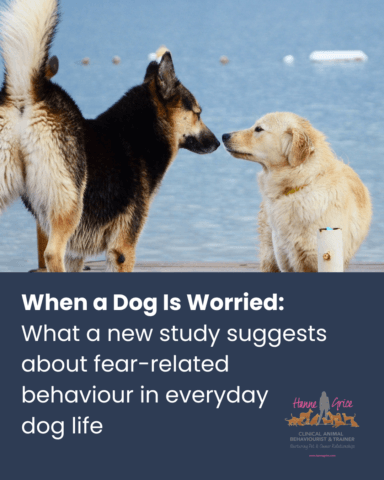
Across the nine questions, 91% of dogs were reported by their owners as showing at least one mild/moderate fear response or higher. When nail trims and bathing were excluded, the figure dropped to 84%. To be included in the 91%, a dog needed only one mild/moderate rating across the nine questions. This means that a dog who was reported to settle with visitors, or seemingly cope with traffic and other dogs, yet was worried about nail trims, would sit within the same broad figure as a dog who struggled across several areas of life.
So, the 91% figure should be treated with caution, and Beaver’s study (2026) is best read as evidence that fear-related signs are commonly reported in pet dogs, rather than evidence that most dogs have a clinical anxiety disorder.
While signs such as freezing, moving away, trembling, hiding, tail-tucking or trying to escape may be brief in one dog, they can be severe in another. Either way, they suggest the dog is finding something difficult, and Beaver’s study encourages owners to look more closely at patterns: what happened, how close the “trigger” was to the dog, how the dog responded, and how long it took the dog to recover.
Previous research also shows high levels of owner-reported anxiety-like traits, although figures vary because the research questions, thresholds and populations vary. For example, Salonen et al. (2020) reported anxiety-like traits in 72.5% of 13,700 Finnish pet dogs, with noise sensitivity and fearfulness among the most commonly reported traits. Blackwell et al. (2013) found that owner recognition changes with the way questions are asked; people may report trembling, hiding or escape attempts without necessarily describing their dog as fearful. Many dogs may show fear-related signs in ordinary situations, yet those signs are not always recognised as welfare information.
Beaver’s study (2026) also highlights the impact unfamiliar dogs can have on ordinary walks, as nearly half of the dogs were rated as showing at least mild/moderate fear or anxiety around unfamiliar dogs. Consider narrow pavements, canal paths, on-lead greetings, busy parks and off-lead dogs rushing over. These can put dogs under pressure well before barking or lunging appears. Stopping, dropping down, stiffening, scanning, hiding behind the owner, jumping up at them, or suddenly snatching food roughly from the handler can suggest the dog is already close to their threshold limit of coping.
Beaver’s grooming data is also relevant to day-to-day welfare. Of the 43,517 dog participants, 35.2% showed at least mild/moderate fear around nail trims, and 22.3% showed at least mild/moderate fear around bathing. For some dogs, the appearance of the towel, clippers or being called into the bathroom may predict restraint. Where an owner chases, pins down, ties up, or rushes their dog to get the task done, future attempts can become harder. Teaching cooperative care, working at the dog’s pace, or engaging groomers who use stress-free handling can give the dog more predictability and choice, reducing stress and the potential for behaviour to escalate.
As the study recorded owner-reported fear and anxiety, it cannot tell us why each dog responded as they did in everyday situations. There are many factors that can influence fear and anxiety-related behaviours, including painful or uncomfortable conditions such as sore ears, dental problems, skin disease, gastrointestinal discomfort or musculoskeletal pain. Ageing, previous experience and handling sensitivity can also alter how a dog copes. A dog who suddenly becomes overreactive, touch-sensitive, distressed by sudden sounds or movement, restless, clingy, or difficult to groom needs veterinary input and behavioural support (Lopes Fagundes et al., 2018; Mills et al., 2020).
What owners can do next
To support your dog day to day, watch out for the less obvious signs of unease, which could include pausing, turning their head away, no longer wanting a treat, suddenly becoming “selective” in their hearing, or taking longer to recover after an event. Recognising these signs early can help owners respond more appropriately: increasing distance from the things that prompted the response, reducing pressure by avoiding forced dog-dog greetings, breaking grooming into smaller steps, and planning ahead for predictable noise events such as fireworks.
If a dog’s fear is escalating, spreading into new contexts, or appearing alongside growling, snapping or biting, support from a qualified behaviourist is needed. The Animal Behaviour and Training Council (ABTC) Practitioner Directory lists practitioners who have been independently assessed to work at the level they advertise and can work collaboratively with your vet.
References
- Beaver, B.V. (2026) ‘Owner-reported prevalence and severity of fear and anxiety in dogs’, Veterinary Research Communications, 50, article 284. Available at: https://doi.org/10.1007/s11259-026-11227-y
- Blackwell, E.J., Bradshaw, J.W.S. and Casey, R.A. (2013) ‘Fear responses to noises in domestic dogs: prevalence, risk factors and co-occurrence with other fear related behaviour’, Applied Animal Behaviour Science, 145(1–2), pp. 15–25. Available at: https://doi.org/10.1016/j.applanim.2012.12.004
- Lopes Fagundes, A.L., Hewison, L., McPeake, K.J., Zulch, H. and Mills, D.S. (2018) ‘Noise sensitivities in dogs: an exploration of signs in dogs with and without musculoskeletal pain using qualitative content analysis’, Frontiers in Veterinary Science, 5, 17. Available at: https://doi.org/10.3389/fvets.2018.00017
- Mills, D.S., Demontigny-Bédard, I., Gruen, M., Klinck, M.P., McPeake, K.J., Barcelos, A.M., Hewison, L., Van Haevermaet, H., Denenberg, S., Hauser, H., Koch, C., Ballantyne, K., Wilson, C., Mathkari, C.V., Pounder, J., Garcia, E., Darder, P., Fatjó, J. and Levine, E. (2020) ‘Pain and problem behavior in cats and dogs’, Animals, 10(2), 318. Available at: https://doi.org/10.3390/ani10020318
- Salonen, M., Sulkama, S., Mikkola, S., Puurunen, J., Hakanen, E., Tiira, K., Araujo, C. and Lohi, H. (2020) ‘Prevalence, comorbidity, and breed differences in canine anxiety in 13,700 Finnish pet dogs’, Scientific Reports, 10, 2962. Available at: https://doi.org/10.1038/s41598-020-59837-z
Learn more about our classes
Get Hanne's book, clothing and more
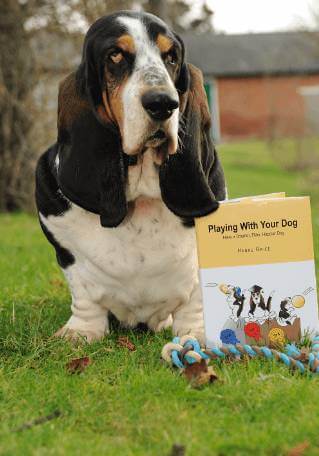
Hanne has a number of publications including her book Playing With Your Dog to help owners work out the games that are best suited for their pet to play throughout his life, from puppyhood to old age, available from Amazon. Check out Hanne's range of contemporary casuals The Collection – for pet lovers made from recyclable, organic materials that are sustainably sourced.