The other day, I was out walking with a friend when she told me she had offered to let her unlucky-in-love friend take her dog out for a walk. She was joking, though there is logic behind it. Dogs do tend to make social contact easier. As an eternal geek, the conversation quickly turned to the research on why having a dog can make someone seem more attractive to other people, and the findings tell us at least as much about human psychology as they do about dogs or cats.

Research suggests that companion animals can influence how people are perceived in dating contexts. Gray et al. (2015) found that pets played a meaningful role in mate appraisal and mate selection among single adults in the United States, with dogs carrying more weight than cats as social tools within dating. Rather than animals making someone instantly attractive, this looks more like rapid impression formation. Having a pet becomes a social cue from which people infer warmth, empathy, reliability, routine and the capacity to care, qualities that matter when people are scanning for signs of compatibility.
Companion animals often sit within human attachment and caregiving systems, which helps explain why they are rarely read as neutral background detail (Archer, 1997). In courtship, a dog or cat can become folded into broader judgements about character, closeness and the sort of everyday life a person might offer. People are responding not only to the animal, but also to what they think the animal says about the human standing beside them. Psychologists sometimes describe this kind of snap reading as thin-slice judgement, the habit of building surprisingly confident impressions from very limited information. That helps explain why animal affiliation can matter even before anybody has had much chance to demonstrate who they are in more substantial ways. In this sense, the pet becomes part of what is being read.
Dogs can also alter the social environment itself. McNicholas and Collis (2000) found that dogs act as catalysts for social interaction, increasing the likelihood that strangers will stop and speak to the person accompanied by the dog. In effect, a dog lowers the threshold for approach by giving strangers something obvious, socially safe and faintly cheerful to comment on. I lost count of how many times people paused to tell me my Basset Hound was a “sausage dog”. For all the talk of chemistry, many relationships begin with nothing grander than somebody simply stopping to say hello to the dog.
Online dating research also highlights people’s perceptions when pets are involved. In a comparative observational study of 2,400 dating profiles in Vienna and Tokyo, Dürnberger and Springer (2022) found that 15.5 per cent included at least one photograph featuring an animal, with dogs appearing most often and cats second most. That does not mean everyone with a Labrador in their profile picture is engaged in some masterclass in strategic self-presentation. It does suggest, though, that people understand pets as social shorthand. In social psychological terms, they become part of self-presentation, a cue about lifestyle like being ‘outdoorsy’, domesticity, values and identity that may feel more legible, and therefore more appealing, to somebody scanning quickly for signs of fit.
Looking at cats and appeal, Kogan et al. (2020) found that young heterosexual women rated men pictured holding cats as less masculine and less dateable than the same men pictured alone. Psychologically, this fits with gender schema theory and rapid impression formation. The women in the study were not really judging the cat so much as reading the man through a cultural template of what masculinity is supposed to look like. In that sense, the cat becomes a screen onto which assumptions about masculinity, softness, domesticity and care are projected. Cats are not disrupting attraction so much as revealing the rules some people are using to judge it. Though, in the interests of balance, Travis Deslaurier rather complicates matters!
There is also a less flattering side to all this, one that matters from a clinical animal behaviourist perspective. If a calm dog can make somebody seem approachable, a distressed or over-reactive dog may alter that impression as well. Hart and King (2024) identified recurring themes of public misunderstanding, unfair judgement, stress and reduced ease in social life among guardians of reactive dogs. While their study was not about courtship, it does support a broader point: people often read the human and the animal together. From a social psychological perspective, that edges into stigma, where the dog’s public behaviour becomes part of the owner’s social identity. Behaviour, especially in public, can become part of the social biography of the person holding the lead. I explored the wider physiological and psychological impact of undesirable pet behaviour on owners in more detail in a previous article.
Perhaps that is the real point here. Pets do not magically make someone attractive. They reveal how quickly humans infer character from care, and how readily we turn animals into clues about the person beside them. In my case, reading a dating profile in 2011 mentioning a Cocker Spaniel and a Newfoundland was always likely to catch my eye. Just as well, really. Otherwise, I might have overlooked the future father of my children.
References
- Archer, J. (1997) ‘Why do people love their pets?’, Evolution and Human Behavior, 18(4), pp. 237–259. Available at: https://doi.org/10.1016/S0162-3095(99)80001-4.
- Dürnberger, C. and Springer, S. (2022) ‘Wanna See My Dog Pic? A Comparative Observational Study of the Presentation of Animals on Online Dating Profiles in Vienna and Tokyo’, Animals, 12(3), 230. Available at: https://doi.org/10.3390/ani12030230.
- Gray, P. B., Volsche, S. L., Garcia, J. R., and Fisher, H. E. (2015). The Roles of Pet Dogs and Cats in Human Courtship and Dating. Anthrozoös, 28(4), 673–683. Available at: https://doi.org/10.1080/08927936.2015.1064216
- Hart, C.J. and King, T. (2024) ‘“It’s Okay He’s Friendly”: Understanding the Experience of Owning and Walking a Reactive Dog Using a Qualitative Online Survey’, Anthrozoös, 37(1), pp. 1–22. Available at: https://doi.org/10.1080/08927936.2023.2287314.
- Kogan, L.R., Volsche, S.L., Erdman, P. and Schoenfeld-Tacher, R. (2020) ‘Not the Cat’s Meow? The Impact of Posing with Cats on Female Perceptions of Male Dateability’, Animals, 10(6), 1007. Available at: https://doi.org/10.3390/ani10061007.
- McNicholas, J. and Collis, G.M. (2000) ‘Dogs as Catalysts for Social Interactions: Robustness of the Effect’, British Journal of Psychology, 91(1), pp. 61–70. Available at: doi: 10.1348/000712600161673.
Related reading
- Grice, H. (2024) ‘The physiological and psychological impact of undesirable pet behaviour on owners and strategies for overcoming overwhelm’, Hanne Grice Pet Training & Behaviour. Available at: https://www.hannegrice.com/walk-the-dog/the-physiological-and-psychological-impact-of-undesirable-pet-behaviour-on-owners-and-strategies-for-overcoming-overwhelm/
Learn more about our classes
Get Hanne's book, clothing and more
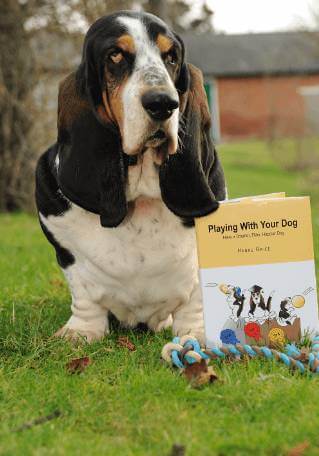
Hanne has a number of publications including her book Playing With Your Dog to help owners work out the games that are best suited for their pet to play throughout his life, from puppyhood to old age, available from Amazon. Check out Hanne's range of contemporary casuals The Collection – for pet lovers made from recyclable, organic materials that are sustainably sourced.