
A recent study by Gardeweg et al. (2026) found that people are generally good at recognising pain in dogs when it affects movement, and much less certain when pain is expressed through behaviour. The participants included both dog owners and non-dog owners, and dog ownership did not appear to give any clear advantage when the signs were less obvious. Overt, movement-linked pain, such as limping, was recognised more readily than subtler patterns such as night-time restlessness and increased shadowing of family members. A similar split appeared in the behavioural signs themselves, with change in personality, hesitant paw lifting, fluctuating mood and reduced play more readily associated with pain, whereas yawning, nose licking and air sniffing were much less likely to be interpreted that way. The authors also suggested that dog owners may be more inclined to interpret behaviours such as turning the head or body away, and freezing, as signs of stress or fear rather than as possible indicators of pain (Gardeweg et al., 2026).

How the study was designed
Participants were asked to interpret three written case scenarios. Those who had previously lived through a dog’s painful illness, accident or treatment were more likely to interpret the subtler case as pain-related than those without that background. They also completed an online questionnaire rating 17 listed behavioural signs. The wider questionnaire included AI-generated dog images rather than footage or photographs of real dogs, though those image data were not analysed in this paper (Gardeweg et al., 2026).
Study limitations
As with any study, there are limitations. This was a convenience sample, meaning the researchers recruited people who were readily accessible rather than drawing a more systematically representative sample, and it was heavily female, while the owner and non-owner groups also differed in age. Many of the non-dog owners had also lived with dogs before, so this was not a clean comparison between experienced owners and complete novices. That means the findings cannot automatically be assumed to represent the wider population. The questionnaire also used the term “pain” rather than the broader concept of “discomfort”, and participants were not given a formal definition of pain before responding. Consequently, that narrows the claims the paper can support, so it is better read as a study of how people interpret behavioural information when pain is one possible explanation, rather than a direct test of how accurately they identify pain in real dogs in everyday life (Gardeweg et al., 2026).
What this means in practice
The findings fit with earlier work on pain and behaviour in dogs and cats. Mills et al. (2020) argued that painful conditions may cause, exacerbate or maintain behaviour problems in dogs and cats, and that the behavioural relevance of pain remains under-recognised in practice. Drawing on their own referral caseloads, including a review of 100 recent dog cases contributed by several of the authors, they suggested that a conservative estimate of around a third involved some form of painful condition, and in some instances, the figure may have been closer to 80 per cent. More recent work on chronic pain has associated it with reduced activity, poorer sleep quality, altered social interaction, changes in posture and gait, and broader disruption to welfare and quality of life (Malkani et al., 2024). Research on canine osteoarthritis also suggests that owner-completed screening tools can help identify dogs whose pain might otherwise remain undetected (Wright et al., 2022).
That is why, in behavioural practice, the possibility of physical discomfort should always be explored when a dog’s behaviour begins to change. Clinical animal behaviourists work on veterinary referral because changes in movement, posture, touch sensitivity, settling, arousal, avoidance, social tolerance, or escalation into growling, lunging or biting are not interpreted in isolation. They are considered alongside medical history, veterinary findings, careful history-taking, validated psychometric tools, behavioural observations, and the dog’s learning and environmental context. ABTC guidance for veterinary professionals states that Clinical Animal Behaviourists, Veterinary Behaviourists and Accredited Animal Behaviourists work with animals demonstrating undesirable, inappropriate, problematic or dangerous behaviour and will only see clients on veterinary referral.
For dog guardians, the practical takeaway from Gardeweg et al.’s (2026) research is that if a dog has started to alter in their behaviour, particularly across sleep, play, sociability, movement, grooming, tolerance, or day-to-day coping, that shift should not be dismissed simply because there is no obvious limp or stiffness. The first step is to speak to their veterinary surgeon so that pain, illness, and physical discomfort can be properly explored. Where behaviour change forms part of the clinical picture, an appropriately qualified Clinical Animal Behaviourist working on veterinary referral can help build a fuller understanding of what is happening and how best to support the dog and guardian. To find a registered professional in your postcode area, see the ABTC’s Practitioner Directory.
References
- Animal Behaviour and Training Council (2022) Information for Veterinary Professionals: How to find a qualified, assessed and regulated behaviourist and what constitutes referral to a behaviourist. Available at: https://abtc.org.uk/wp-content/uploads/2022/03/Information-for-Veterinary-Professionals-how-to-find-behaviouist-what-constitutes-referral-March-2022.pdf
- Gardeweg, S.M.A., Picard, D.E. and van Herwijnen, I.R. (2026) ‘The abilities in dog pain sign recognition as assessed by presenting seventeen listed dog behavioural signs and three case descriptions to dog owners and non-dog owners’, PLOS ONE, 21(4), e0344512. Available at: https://doi.org/10.1371/journal.pone.0344512
- Malkani, R., Paramasivam, S. and Wolfensohn, S. (2024) ‘How does chronic pain impact the lives of dogs: an investigation of factors that are associated with pain using the Animal Welfare Assessment Grid’, Frontiers in Veterinary Science, 11, 1374858. Available at: https://doi.org/10.3389/fvets.2024.1374858
- Mills, D.S., Demontigny-Bédard, I., Gruen, M., Klinck, M.P., McPeake, K.J., Barcelos, A.M., Hewison, L., Van Haevermaet, H., Denenberg, S., Hauser, H., Koch, C., Ballantyne, K. and Mathkari, C.V. (2020) ‘Pain and problem behavior in cats and dogs’, Animals, 10(2), 318. Available at: https://doi.org/10.3390/ani10020318
- Wright, A., Amodie, D.M., Cernicchiaro, N., Lascelles, B.D.X., Pavlock, A.M., Roberts, C. and Bartram, D.J. (2022) ‘Identification of canine osteoarthritis using an owner-reported questionnaire and treatment monitoring using functional mobility tests’, Journal of Small Animal Practice, 63(8), pp. 609–618. Available at: https://doi.org/10.1111/jsap.13500
Learn more about our classes
Get Hanne's book, clothing and more
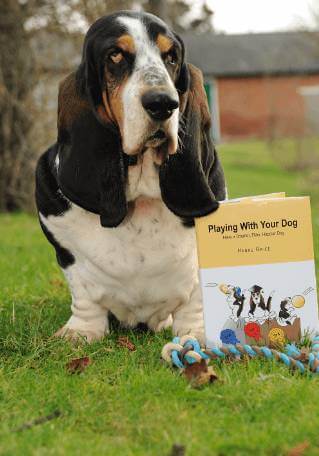
Hanne has a number of publications including her book Playing With Your Dog to help owners work out the games that are best suited for their pet to play throughout his life, from puppyhood to old age, available from Amazon. Check out Hanne's range of contemporary casuals The Collection – for pet lovers made from recyclable, organic materials that are sustainably sourced.