
Frustration quietly underpins many behaviour challenges in companion animals. It often appears as lead reactivity, such as lunging and barking at a dog they cannot reach, pacing, vocalising at windows, difficulty settling, or explosive greetings. When misread as stubbornness or defiance, frustration support is delayed, and consequently, patterns intensify. Behavioural science, in contrast, identifies frustration as a distinct emotional process with welfare implications.
When expectation meets obstruction
Frustration arises when an animal anticipates access to something meaningful, and that access is blocked. Food, social contact, movement, exploration, or human attention can all become expectation targets. Experimental research across species shows that repeated blocked goals trigger increased arousal and measurable stress responses, alongside reduced cognitive flexibility (Amsel, 1992; Arnsten, 2009). In other words, the animal’s ability to adapt narrows when expectation and outcome repeatedly mismatch.
In dogs, frustration has been specifically measured using the Canine Frustration Questionnaire, which links frustration-proneness with observable behavioural patterns and physiological stress markers (McPeake et al., 2019; McPeake et al., 2021). These studies show that frustration is not simply a training issue, but an emotional state with clear welfare implications.

Why behaviour can become repetitive
When frustration accumulates, animals are more likely to repeat high-arousal behaviours and less able to shift into calmer strategies. Observational studies in pet dogs note increased vocalisation, displacement behaviours, repetitive motor patterns, and heightened reactivity when access to expected goals is blocked (Jakovcevic et al., 2013). Over time, these responses can become learned coping patterns rather than isolated incidents.
Tolerance for frustration is shaped by learning history, temperament, environmental predictability, and physical comfort. Pain and fatigue lower tolerance for blocked goals, while inconsistent routines or unclear cues increase uncertainty (Mills et al., 2014). These interacting factors explain why frustration looks different across individual animals and in different situations.
Supporting frustration tolerance
Reducing frustration never means removing all challenge. It means making life more predictable, communication clearer, and giving animals safe ways to wait when something they want is briefly out of reach.
When frustration is supported, tolerance grows, animals stay more flexible in their responses, and learning remains available and more effective – helping for calmer interactions for you and your pet.
🧬 Learn more with my episode, the Frustration Threshold to see what supporting frustration looks like in everyday life. Click here to watch the Science of Connection playlist.
References
- Amsel, A. (1992) Frustration Theory: An Analysis of Dispositional Learning and Memory. Cambridge: Cambridge University Press.
- Arnsten, A.F.T. (2009) ‘Stress signalling pathways that impair prefrontal cortex structure and function’, Nature Reviews Neuroscience, 10(6), pp. 410–422. https://doi.org/10.1038/nrn2648
- Jakovcevic, A., Elgier, A.M., Mustaca, A.E. and Bentosela, M. (2013) ‘Frustration behaviors in domestic dogs’, Journal of Applied Animal Welfare Science, 16(1), pp. 19–34. https://doi.org/10.1080/10888705.2013.740974
- McPeake, K.J., Collins, L.M., Zulch, H. and Mills, D.S. (2019) ‘The Canine Frustration Questionnaire: Development of a new psychometric tool for measuring frustration in domestic dogs (Canis familiaris)’, Frontiers in Veterinary Science, 6, 152. https://doi.org/10.3389/fvets.2019.00152
- McPeake, K.J., Collins, L.M., Zulch, H. and Mills, D.S. (2021) ‘Behavioural and physiological correlates of the Canine Frustration Questionnaire’, Animals, 11(12), 3346. https://doi.org/10.3390/ani11123346
- Mills, D.S., Karagiannis, C. and Zulch, H. (2014) ‘Stress – its effects on health and behaviour: a guide for practitioners’, Veterinary Clinics of North America: Small Animal Practice, 44(3), pp. 525–541. https://doi.org/10.1016/j.cvsm.2014.01.005
Learn more about our classes
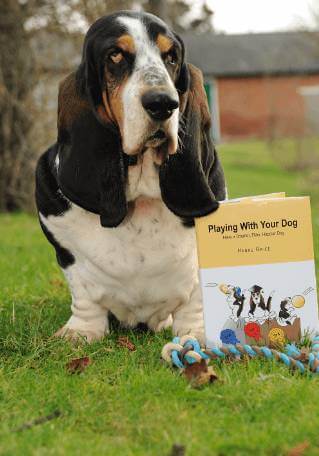
Get Hanne's book, clothing and more
Hanne has a number of publications including her book Playing With Your Dog to help owners work out the games that are best suited for their pet to play throughout his life, from puppyhood to old age, available from Amazon. Check out Hanne's range of contemporary casuals The Collection – for pet lovers made from recyclable, organic materials that are sustainably sourced.