
Do pets really reduce stress, or is the “pet effect” more complicated than the headlines suggest?
In this Science of Connection episode, I look at a recent study by Peeters et al. (2026), which examined everyday interactions between dog and cat owners and their animals. The study found that people reported slightly better mood during moments when they interacted more with their pets, but did not find evidence that pets acted as reliable stress buffers.
Watch the episode below.
Companion animals are often spoken about as though their benefits are automatic. The familiar idea is that dogs, cats and other animals help us cope better, feel calmer, and recover more easily from stressful moments.
Human-animal interaction research has long examined the “pet effect”, a broad term used to describe possible links between animal companionship and human wellbeing. Some studies have found positive associations, including reduced loneliness, increased social contact, more routine, greater physical activity, and emotional support. Other studies have found weaker, mixed or even negative associations, particularly where pet ownership involves illness, grief, cost, disrupted sleep, behaviour problems or caregiving strain.
And that mixed bag of findings is not surprising given that pet ownership is not one single experience. Experiences can range from a settled dog who enjoys a gentle stroke, a cat that chooses to sit near us, to an elderly animal needing complex care, or a dog that is struggling with over-reactive behaviours when out and about. All these different experiences can sit under the same broad ‘interaction’ label. Yet their effects on human wellbeing are unlikely to be the same.
The Peeters et al. (2026) study is useful because it looked at interaction in everyday life. Rather than asking people to think back across a long period, the researchers used a phone-based diary method. Owners reported their mood, daily experiences, activity stress and level of interaction with their dog or cat several times a day.
People reported slightly better mood during moments when they interacted more with their animals. That supports what many owners describe: interaction with a familiar animal can be associated with feeling a little better. However, the study found no evidence that pets reduced the emotional impact of stressful events or demanding activities. In other words, our animals may give us a small momentary lift, but in this study, they did not act as reliable stress buffers.
Feeling better around an animal is not the same as being protected from stress. While a pet may provide routine, contact, play, social connection, humour, and a reason to get outside, those are meaningful parts of daily life. They are not all the same psychological mechanism.
For owners, the practical point is not to dismiss the comfort animals can bring. It is to notice the quality of the interaction. More contact is not automatically better. Animals need opportunities to approach, participate, and move away when they have had enough.
The better question is not simply whether pets are good for us. It is what kind of interaction is happening, with which animal, with which person, and in what context.
The pet effect is real for many people, but it is not magic, and it is not one-size-fits-all. The healthiest human-animal connections are built around mutual comfort, good observation, and respect for the animal’s choice.
Further Reading
- Barcelos, A.M., Kargas, N., Maltby, J., Hall, S., Assheton, P. and Mills, D.S. (2021). Theoretical foundations to the impact of dog-related activities on human hedonic well-being, life satisfaction and eudaimonic well-being. International Journal of Environmental Research and Public Health, 18, 12382. https://doi: 10.3390/ijerph182312382.
- Janssens, M. et al. (2020). The pet-effect in daily life: an experience sampling study on emotional wellbeing in pet owners. Anthrozoös, 33, 579–588. https://doi.org/10.1080/08927936.2020.1771061
- Peeters, S., Jacobs, N., Hediger, K., Eshuis, J. and Janssens, M. (2026). Human-animal interaction: understanding the role of dog and cat interactions in emotional wellbeing. Frontiers in Psychology, 17, 1768288. https://doi.org/10.3389/fpsyg.2026.1768288
- Rodriguez, K.E., Herzog, H. and Gee, N.R. (2021). Variability in human-animal interaction research. Frontiers in Veterinary Science, 7, 619600. https://doi.org/10.3389/fvets.2020.619600
Learn more about our classes
Get Hanne's book, clothing and more
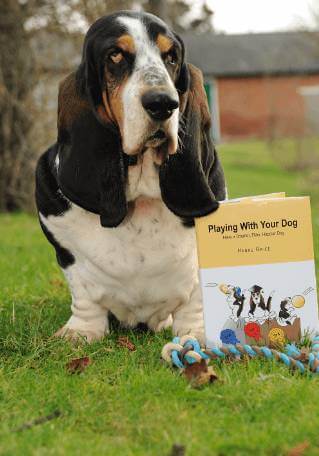
Hanne has a number of publications including her book Playing With Your Dog to help owners work out the games that are best suited for their pet to play throughout his life, from puppyhood to old age, available from Amazon. Check out Hanne's range of contemporary casuals The Collection – for pet lovers made from recyclable, organic materials that are sustainably sourced.