Sleep is one of those areas where the science and the animal profession are largely aligned. We know it matters, we understand its role in welfare, development, and recovery. Yet where things become more complicated is in how directly sleep quality feeds into day-to-day behaviour, emotional regulation, and learning capacity in real-world home environments.
From a nervous system perspective, depth and continuity of rest matters.
Across mammalian sleep research, deeper, less fragmented sleep is strongly associated with emotional regulation and learning consolidation. Studies on dog learning show similar patterns: animals that receive adequate sleep or rest after learning retain information more reliably (Kris et al., 2017).
Research shows that sleep loss can increase threat centre activity in the brain by around 60 per cent in humans (Yoo et al., 2007). While we still lack large numbers of long-term, naturalistic, home-environment sleep studies in companion animals, we can examine broader mammalian data alongside what we know in dogs and infer that the overall direction is consistent. Quality sleep supports regulation, regulation supports learning, and learning supports behaviour stability. Where this becomes particularly relevant is in behaviour work. Behaviour modification plans rely on the brain being in a state where learning is affordable. If recovery between stress events is slower, or baseline arousal sits slightly higher, learning costs more. It does not make behaviour change impossible. It just makes it harder work for everyone involved.
There is also a relationship layer that rarely gets talked about explicitly. Animals who regulate more easily, recover more quickly, and process learning efficiently tend to find shared environments easier to navigate. And when animals find shared environments easier, relationships often feel easier too.
In practical terms, improving sleep quality is rarely about a dramatic lifestyle change. It is usually about reducing repeated disruption and giving animals genuine opportunities to switch off. For dogs, that might mean a consistent place where they can rest away from late-evening household activity. For cats, it often means more genuine choice about where to rest, more vertical space, and more tucked-away resting options where they feel safe enough to properly switch off.
Beyond providing chill-out spaces for your pets, establishing predictable evening routines that promote decompression can help you feel more confident in supporting their well-being. Whether that is a gentle ‘sniffari’ around the block with your dog, or providing opportunities that encourage licking and chewing (such as antlers, yak cheese chews, lick mats, etc), as well as lowering lighting, and masking unpredictable household noise with calming music, can all help protect the depth and continuity of rest. And when animals cope better with stress and learn more easily, everyday life between us and our pets tends to feel easier too.
To understand more, check out my episode, the Power of Sleep, below, and explore the full Science of Connection playlist here.
Further Reading
- Chapagain, D., Virányi, Z., Wallis, L., Huber, L. and Range, F. (2018) Aging of attentiveness in Border Collies and other pet dog breeds: The protective benefits of lifelong training. Frontiers in Aging Neuroscience, 10, 100. doi: 10.3389/fnagi.2017.00100
- Goldstein, A.N. and Walker, M.P. (2014) The role of sleep in emotional brain function. Annual Review of Clinical Psychology, 10, 679–708. doi: 10.1146/annurev-clinpsy-032813-153716
- Kis, A., Bognár, Z., Gácsi, M., Topál, J. and Kubinyi, E. (2017) The interrelationship of sleep and learning in dogs. Scientific Reports, 7, 41873. doi: 10.1038/srep41873
- Mills, D.S., Demontigny-Bédard, I., Gruen, M., Klinck, M.P., McPeake, K.J., Barcelos, A.M., Hewison, L., Van Haevermaet, H. and Denenberg, S. (2020) Pain and problem behaviour in cats and dogs. Animals, 10(2), 318. doi: 10.3390/ani10020318
- Monodino, E., Scandurra, A., D’Aniello, B., Doretti, M., Marinelli, L., Mongillo, P. and Prato-Previde, E. (2023) Sleep and cognition in aging dogs: A polysomnographic study. Frontiers in Veterinary Science, 10, 1151266. https://doi.org/10.3389/fvets.2023.1151266
- Walker, M.P. and van der Helm, E. (2009) Overnight therapy? The role of sleep in emotional brain processing. Psychological Bulletin, 135(5), 731–748. doi: 10.1037/a0016570
- Yoo, S.S., Gujar, N., Hu, P., Jolesz, F.A. and Walker, M.P. (2007) The human emotional brain without sleep — a prefrontal–amygdala disconnect. Current Biology, 17(20), R877–R878. doi: 10.1016/j.cub.2007.08.007
Learn more about our classes
Get Hanne's book, clothing and more
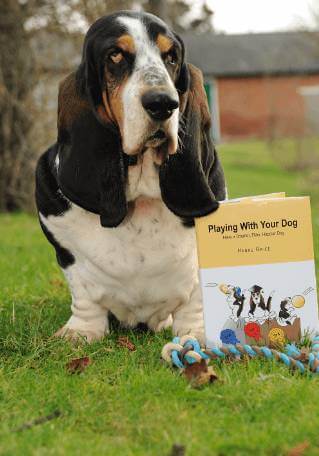
Hanne has a number of publications including her book Playing With Your Dog to help owners work out the games that are best suited for their pet to play throughout his life, from puppyhood to old age, available from Amazon. Check out Hanne's range of contemporary casuals The Collection – for pet lovers made from recyclable, organic materials that are sustainably sourced.