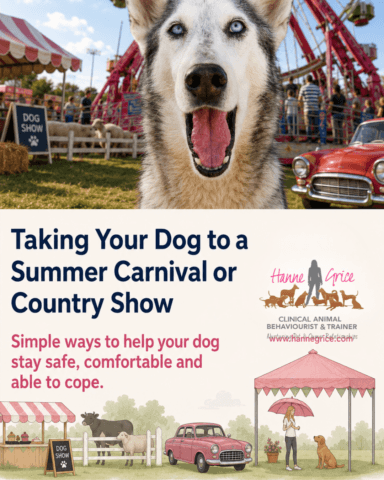
With the Tring Summer Carnival* approaching, it seemed a good time to consider how dogs experience busy summer events. I have supported the Tring Carnival Dog Show as a sponsor for many years and am pleased to continue supporting the Carnival in 2026. Carnivals, village fêtes and country shows can be enjoyable outings for some dogs. For others, the combination of weather, crowds, noise, animals and limited space may prove tiring or difficult.
*UPDATE July ’26: the popular Dog Show organised by Tring Youth Council, has been scheduled for Saturday 19th September ’26 at 11am to 2pm, to beat the heat.
So the question is less whether dogs are allowed to attend and more whether the individual dog is likely to enjoy the experience.
What will your dog make of the day?
Dogs hear a broader range of frequencies than humans. While that doesn’t mean every sound is louder or more distressing to dogs, pitch, volume, duration, predictability, prior experience, and individual sensitivity can all influence a dog’s response.
Classic cars and steam engines are also a staple at such events, and these bring unfamiliar noise, vibration, movement and exhaust odours. Similarly, livestock displays introduce different smells, sounds, body shapes, and patterns of movement to our dogs, and performances involving music, people or animals moving together, and sudden applause all overlap. Add to these public-address systems, barking, children, pushchairs, and crowd noise; suddenly, the dog is being bombarded with noise they cannot escape and movement from several directions, often in spaces where the dog has limited room to move away. While each feature may be manageable in isolation, over several hours, its effects can accumulate.
Then we have smells. A dog’s sense of smell is exceptionally well developed and central to how they experience their surroundings. At country shows and similar events, food, livestock, vehicles, people, grass, waste and other dogs create a dense and changing scent environment. Although these smells may not be inherently unpleasant to the dog, the constant flow of information can, however, become tiring, particularly as the day continues. The dog may be processing considerably more of the event compared to their owner browsing the cake stall! Fatigue can lower the dog’s tolerance, making it harder to cope and increasing the risk of escalation.
How well is your dog coping?
To understand how well your dog is coping at the local show, watch them. Are they moving with a loose body, broad tail sweeps and soft body wiggles? Are they exploring and able to reconnect with you? Can they eat, drink and settle? Do they recover readily following a sudden noise or after an unfamiliar person has approached?
Repeated scanning, slowing down, freezing, refusing food, pulling towards an exit, barking or struggling to settle can suggest that coping is becoming harder. More subtle dog signs may include lowering the body, tucking the tail, shifting weight, turning the head or the whole body away, licking the lips, yawning, seeking cover beneath a chair or trestle table, or remaining unusually close to their person.
So, monitor for changes from your dog’s usual behaviour. Several stress signs appearing together, or difficulty recovering, are your cues to create distance, find somewhere quieter or leave. After all, welfare comes first.
Also be mindful that just because a dog may have coped at a show before, does not mean they can cope in a different context, at a closer distance, in warmer weather or after longer exposure. Just like us, what a dog can cope with in one situation can differ from the next; one dog may quietly observe the event, while another becomes worried, frustrated or highly vocal.
And with that in mind, consider livestock welfare, too. Because a staring, barking or lunging dog may frighten animals confined within pens or display areas. Keep a generous distance, prevent approaches and move away before fixation develops. This reduces the opportunity for your dog to practice unwanted behaviours, and the livestock and their handlers will thank you for it!
Ensure you use secure equipment at such events, for example, a well-fitting Y-shaped harness, collar and lead. Be aware that being on lead can frustrate or worry some dogs when they feel restrained in a busy environment. So, aim for enough distance that your dog can observe without feeling trapped between people, barriers, livestock, dogs or vehicles. Remember the old COVID-19 distancing rule of ‘2 metres’: while that may be enough for one dog and their human, it can be far too close for another.
For a quick reminder before you head out, download my Summer Carnival & Country Show Dog Guide.
Food is everywhere
Dropped food is almost inevitable at public events. Chips, cooked bones, skewers, wrappers, chocolate, onions, grapes, raisins and products containing xylitol may all present medical risks. Rich and fatty scraps can also cause gastrointestinal illness, even when the ingredients themselves are not toxic.
Consider how there can also be a behavioural dimension too. Because a dog may grab food before their person notices, swallow it rapidly when approached, or guard what they have found. Being surrounded by crowds can make intervention harder because other dogs and people may already be close, which can amplify the situation and could result in growling, snapping or biting.
Scan the ground ahead, particularly around food stalls and seating areas. Bring familiar rewards that your dog can tolerate and finds motivating, and make sure your leave cue is well established before the event. If the dog already has something, grabbing at their mouth may increase conflict or prompt them to swallow. Instead, exchange the item for food they value and contact a veterinary practice promptly if they may have ingested something harmful.
Tackling heat and humidity
Dogs lose much of their excess body heat through respiratory evaporation when panting. As humidity rises, evaporation becomes less efficient. Consequently, warm, humid and still conditions may make things difficult for our pets, sooner than the temperature alone suggests. Direct sunlight, limited airflow, hot ground, physical activity and time outdoors also contribute. In addition, heat stress can vary with age, health, body condition, coat, fitness and skull shape. For example, Brachycephalic dogs, including Pugs, French Bulldogs and Bulldogs, require particular care because their airway anatomy can compromise breathing and heat loss.
Be mindful that while panting can occur during heat, humidity and exertion, it can also be triggered by excitement, fear, and frustration, so several causes may be present at once during a busy summer event. So, have a plan for keeping your dog cool and learn to recognise changes that may indicate they are struggling.
Signs of heat stress can include:
- seeking shade or water
- slowing down
- refusing food or play
- persistent or increasingly forceful panting
- a widened mouth
- an elongated tongue
- difficulty settling their breathing after activity
In 2025, the Tring Carnival Dog Show, along with others, were rescheduled because of inclement weather. That was a sensible example of organisers adapting plans around animal welfare. So, before attending your local show, check the temperature, humidity and event updates. Consider these conditions throughout your visit and journey, carry ample fresh water and plan for proper breaks in quiet shade. Take a large umbrella along with you, as this may provide additional shade where natural cover is limited, provided it can be positioned safely. Keep your dog’s physical activity gentle, check the ground surface and know how you will leave promptly if conditions become unsuitable.
There is no universal safe temperature for every dog. While temperature charts can prompt caution, they cannot account for humidity, sunlight, airflow, exertion or individual health.
Heavy or distressed panting, breathing difficulty, vomiting, weakness, confusion, poor coordination, collapse or seizures require urgent action. If this happens, move the dog immediately into a cooler area, begin cooling with cool tap water and contact a veterinary practice immediately. Avoid wrapping them in wet towels, which can warm against the body and restrict continuing heat loss.
The human end of the lead
Summer shows can be great fun, especially the beer tent, and people may be eating, drinking, talking and watching performances while navigating crowds. The person responsible for the dog still needs enough attention available to notice a loose dog, approaching child, dropped food, moving vehicle or early change in their dog’s behaviour while enjoying the event.
Alcohol can affect attention, judgement and response speed. Although there is little research specifically examining alcohol and dog handling at public events, whoever is looking after the dog needs to remain capable of supervising and responding promptly. Just like you would agree with your friends who will be the designated driver on a night out, arrange for one sober adult to take responsibility for the dog when others are drinking. Otherwise, shared responsibility can very easily become nobody’s responsibility.
As a nation of dog lovers, people often approach dogs at events without asking the handler or reading the dog’s behaviour particularly well. They may lean over, reach towards the dog or encourage children to say hello. Feel able to decline these interactions and position yourself between your dog and an approaching person. Having a stock phrase ready, such as “My dog needs some space, thank you”, can make this easier.
Taking part in the dog show
If you are considering entering your dog into a local dog show, the experience should remain enjoyable for the dogs taking part.

Arrive with enough time for your dog to look around before entering a class. Bring comfortable, secure equipment, water, familiar food and something they can rest or settle on. Choose a space away from loudspeakers, livestock pens and busy thoroughfares where possible.
Allow room between dogs in queues and around the ring, as close on-lead greetings can become awkward when leads restrict movement and neither dog can readily leave. Remember, a sociable dog never needs to greet everybody.
Continue watching your dog as the day progresses, especially if you have entered several classes or, hopefully, won one and are due back for Best in Show. Coping changes with heat, fatigue, hunger, noise and accumulated social contact. A dog who entered the first class happily may feel very different an hour later.
It’s OK for Fido to stay at home
Dogs who are fearful of unfamiliar people, reactive around dogs, sensitive to noise, highly interested in livestock, prone to scavenging, unwell, in pain, very young, older or uncomfortable in crowds may find a country show or similar event too demanding. Placing a worried dog into an intense environment does not reliably teach them to cope. Likewise, taking a puppy to such an event in the hope that it will provide socialisation risks overwhelm and sensitisation.
When exposure is too close, prolonged or difficult to escape, fear and arousal can increase. Behaviour work is more productive when the intensity can be controlled, distance can be managed, exposure remains brief, and the dog is still able to observe, learn and recover.
So consider a quiet walk earlier in the day, followed by rest at home, as this may suit some dogs far better than coming along to the show. If you are experiencing behavioural challenges with your dog, then do get in touch.
Finally, for dogs who do attend the show, keep the visit flexible. Give them space, notice changes early and be prepared to leave. A good day out is one where you can enjoy yourself while your dog remains physically safe, retains some choice about interaction and recovers comfortably afterwards.
Take care.
Hanne x
Learn more about our classes
Get Hanne's book, clothing and more
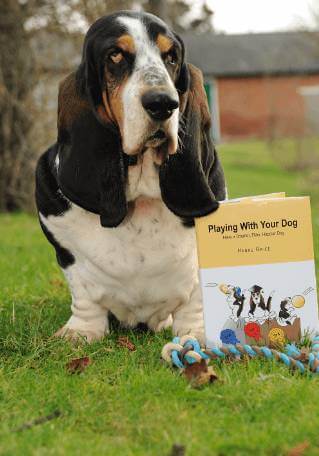
Hanne has a number of publications including her book Playing With Your Dog to help owners work out the games that are best suited for their pet to play throughout his life, from puppyhood to old age, available from Amazon. Check out Hanne's range of contemporary casuals The Collection – for pet lovers made from recyclable, organic materials that are sustainably sourced.